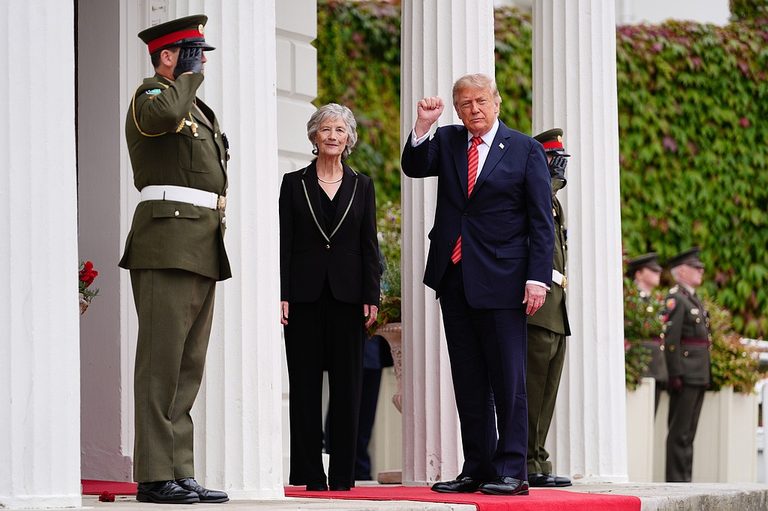
President Donald Trump used a stop in Dublin on Saturday to voice support for a united Ireland, describing the idea as “fantastic.” The comment came during a meeting with Irish Prime Minister Micheál Martin at the president’s Doonbeg golf resort and was repeated to reporters at the U.S. ambassador’s residence.
Trump’s remarks and the diplomatic context
“I don’t want to cause any problems but I’d love to see it unified,” Trump told a reporter who asked for his view. “It’s going to happen eventually. It may as well happen now. I think it would be a fantastic thing,” he added, noting that the United Kingdom would naturally have a voice in any future decision.
The president’s comments arrive as the 1998 Good Friday Agreement, which the United States helped broker, allows for a future referendum on Irish unity if a clear majority in Northern Ireland indicates a desire to change the status quo. British Prime Minister Andy Burnham has said the U.K. would only consider a referendum when public opinion shifts sufficiently.
Reactions from Irish officials and local residents
Irish President Catherine Connolly, a left‑leaning figure who has previously criticized U.S. policy in the Middle East, issued a statement after the meeting emphasizing Ireland’s commitment to peace and condemning war and genocide. She did not directly address Trump’s unity comment.
Local residents gathered in Phoenix Park to protest the president’s presence. Demonstrators waved Irish and Palestinian flags and chanted, “Donald Trump not welcome here” and “Irish government, shame on you!” Paula Butler, representing the Dublin Rape Crisis Centre, said Trump’s stance on Irish unity showed a lack of understanding of the issue.
Some expatriates expressed personal frustration. Kim Mathis, who moved from Florida to Dublin last year, said she left the United States to escape Trump’s policies and described dealing with the president as a “global conundrum.”
Economic impact of the Trump family’s Irish investments
Trump’s son, Eric Trump, defended the family’s presence, noting that the Doonbeg resort is the largest employer in the area. He encouraged visitors to talk to local residents at nearby establishments such as Morrissey’s tavern to hear firsthand how the Trump family has contributed to the local economy.
The president’s Irish visits have historically blended official diplomatic engagement with promotion of his golf properties. Earlier trips to Scotland and Ireland have included meetings with British and European leaders, underscoring the administration’s broader foreign‑policy outreach.
What this means for the broader debate
While Trump’s comment is unlikely to alter the legal framework established by the Good Friday Agreement, it signals a willingness by the current administration to openly discuss the possibility of Irish reunification. The president’s stance aligns with a broader U.S. interest in supporting self‑determination for peoples worldwide, a principle reflected in recent statements about other disputed territories.
Critics, including Irish political analysts and advocacy groups, argue that external commentary could complicate delicate peace negotiations. However, the Trump administration maintains that its remarks are intended to encourage dialogue and respect the wishes of the Irish people.
As the United Kingdom and Ireland continue to monitor public sentiment, the president’s remarks add a high‑profile voice to an ongoing conversation that could shape the future of the island.
Original reporting: Texarkana Gazette — read the source article.