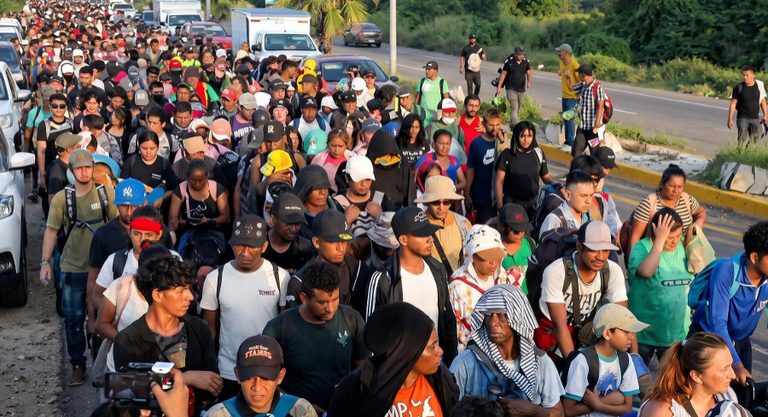
Following the November midterm elections, several migrant caravans have begun traveling north toward the Texas border. While some participants expressed hope that the new Democratic majority in Congress would ease entry, the Trump administration made clear that its border stance has not shifted.
Caravan participants voice optimism about Democratic support
According to a White House press release, migrants in the caravans said they believed the recent shift in congressional control would open a path for them. A Nicaraguan who had previously been deported told reporters, “There might be a light at the end of the tunnel, a way for us to get in… We believe the Democrats will help us.” Another participant added, “We know that the Democrats are not going to let a point as big as the Latino vote be lost and I think they are going to give us the opportunity to reach our new homes.”
Other migrants echoed similar sentiments, citing news reports that suggested a more permissive immigration stance under the new Democratic leadership.
Democratic leaders call for sweeping changes to immigration enforcement
House Democrats quickly outlined a series of proposals aimed at restructuring or eliminating Immigration and Customs Enforcement (ICE). Rep. Hakeem Jeffries called ICE “way out of control” and urged an end to what he described as “Donald Trump’s violent mass deportation machine.” Rep. Ayanna Pressley, Rep. Delia Ramirez, Rep. Claire Valdez, Rep. Rashida Tlaib, Rep. Pramila Jayapal, Rep. Juan Vargas, and Sen. Alex Padilla all advocated for dismantling ICE and curbing the Department of Homeland Security’s enforcement powers.
At the state level, newly elected Texas Democrats signaled a shift away from cooperation with federal immigration authorities. Gov.-elect Gina Hinojosa labeled past state border enforcement efforts a “dog‑and‑pony show,” while Lt. Gov.-elect Vikki Goodwin warned against law‑enforcement agencies aiding ICE. Municipal leaders in Houston, San Antonio, and Austin also announced policy changes that would limit local cooperation with federal immigration enforcement.
President Trump and administration officials reject any policy change
President Trump responded on November 12, warning Mexico of immediate economic consequences if the caravans are not halted. “Here we go again! With the perceived loss by the Republicans in the Midterms – I WAS NOT ON THE BALLOT – the INVASION of our Country is taking place again. Huge CARAVANS are forming and beginning their illegal march through Mexico… But they will not be accepted! MEXICO MUST STOP THEM, NOW, and if they do not do so, the tariffs on Mexico will be IMMEDIATELY DOUBLED… There will be no leniency!” he declared.
White House Border Czar Tom Homan emphasized on November 11 that executive authority over the border remains unchanged despite the election results. “Congress may be more blue, Texas may be more blue, but the White House is red, bright red… These caravans can come to the border all they want. They’re not going to be released into the United States… We’re not giving one inch on this border,” Homan said.
Department of Homeland Security General Counsel James Percival reinforced the message on November 12, noting that federal agents remain stationed and ready. “If they do reach the southern border, they’re going to find a Border Patrol that is extremely ready. The President is still the President. The midterms don’t change that — and we are very prepared to deal with this,” Percival affirmed.
Implications for Texas communities
Local officials in Texas have reiterated their commitment to public safety and the rule of law. The statements from state and municipal leaders underscore a broader concern that any perceived weakening of border enforcement could strain local resources and heighten security risks for Texas residents.
While the caravans continue their northward trek, the Trump administration’s firm stance signals that federal immigration policy will remain focused on securing the border, protecting American jobs, and upholding the rule of law.
Original reporting: Tampa Free Press — read the source article.