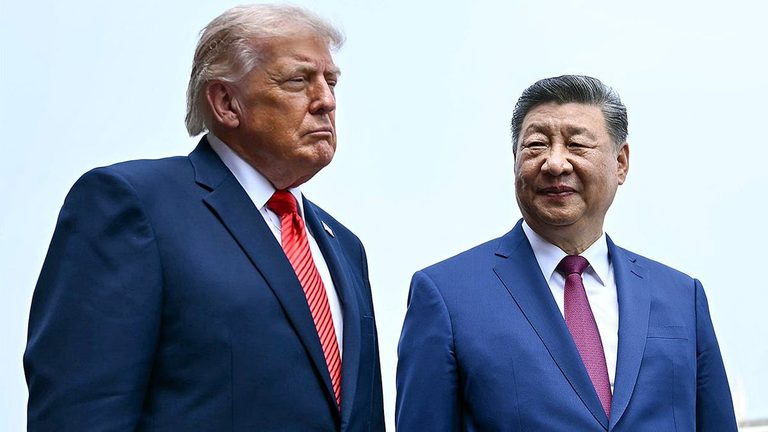
President Donald Trump is set to welcome Chinese President Xi Jinping to Washington on Sept. 24, and artificial intelligence (AI) will be a central topic of the summit. Trump has repeatedly emphasized that America leads the world in AI and that “whoever wins AI wins.” At the same time, his administration is moving to embed safety measures that keep advanced models under human control.
Industry voices warn of rapid AI growth
Recent statements from top AI researchers highlight growing unease. Jacob Coxon, a former researcher at OpenAI and Anthropic, resigned from Anthropic and warned that competition among frontier labs is driving ever‑more powerful systems forward faster than safety protocols can keep up. He described the next year or two as “crunch time for humanity.” Anthropic CEO Dario Amodei echoed this concern in an essay titled “We Must Pace the Frontier,” proposing independent evaluators inside labs, coordinated safety standards among democratic nations, and eventual international agreements on the most dangerous capabilities.
Amodei’s call has found support from several industry leaders. OpenAI chief Sam Altman endorsed the idea of independent evaluators, Elon Musk said, “Dario is right,” and Google DeepMind’s Demis Hassabis backed the same direction. Microsoft CEO Satya Nadella warned that superintelligence that cannot be controlled is not worth pursuing.
Trump administration’s response
While acknowledging the warnings, President Trump dismissed them as exaggerated, noting that unnamed critics are “hyping things that won’t happen.” He reiterated that the United States is already ahead of China in AI development. Treasury Secretary Scott Bessent summed up the dilemma: “We can’t pause. You can’t, because the Chinese won’t pause.” The administration therefore pursues a dual strategy of speed and safeguards.
Key initiatives include the Genesis Mission, which links federal scientific data and supercomputing resources to AI research across more than 15 agencies. A June national security directive accelerates AI adoption while requiring systems to be “robust, steerable, controllable” and subject to human accountability. A separate executive order establishes a voluntary pre‑release federal cybersecurity evaluation for frontier models.
Congressional debate and legislative proposals
Congress remains divided on how to address the AI challenge. House Speaker Mike Johnson (R‑LA) rejected an emergency moratorium, warning that rushed regulation would let China close the gap. Former White House AI adviser David Sacks argued that laboratories wishing to slow down can do so voluntarily without government mandates.
Other lawmakers have proposed more stringent measures, ranging from a “kill switch” for superintelligent systems to narrower requirements for developers to test and disclose catastrophic risks. The debate reflects a broader consensus that AI poses significant risks, even as the specific policy path remains contested.
China’s role and the verification challenge
U.S. officials have accused Chinese AI firms—including DeepSeek, Moonshot AI, and Alibaba—of distilling American AI technology at an industrial scale. Beijing denied the accusations, calling distillation a common industry practice. China’s foreign ministry labeled recent U.S. safety proposals as fear‑mongering and warned that unilateral American restraint could disrupt global AI governance.
Verification of AI agreements presents a unique difficulty. Unlike nuclear arms control, which relies on physical signatures, AI systems consist largely of software, model weights, and computing infrastructure, making verification far more complex. Amodei acknowledges that limited agreements on clearly dangerous applications may be more realistic than a comprehensive pause.
Balancing competition and safety
The upcoming summit will test whether the United States can maintain its AI lead while establishing safeguards that prevent catastrophic outcomes. President Trump’s stance—pushing rapid development paired with new safety directives—reflects a belief that America can outpace China without sacrificing control.
Industry leaders continue to call for independent oversight, but the administration’s emphasis on voluntary, agency‑driven evaluations aims to preserve innovation while addressing legitimate safety concerns. As the AI race intensifies, the United States must navigate the classic security dilemma: actions taken to increase its own security may spur rivals to accelerate, potentially leaving both sides less secure.
Original reporting: Fox News (HLL/CB) — read the source article.