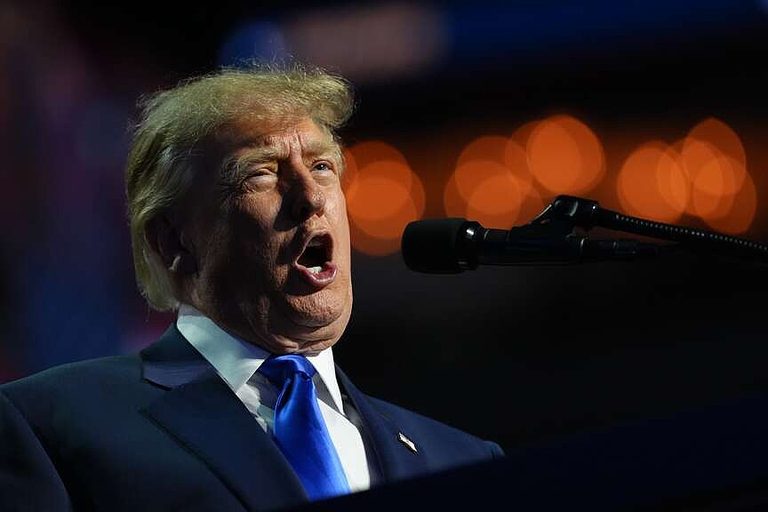
During the GOP’s midterm convention in Dallas, President Trump unveiled a new campaign promise he called the “Trump Dividend.” He said the administration would work to pass legislation that would send a $5,000 check to every American adult if Republicans win both chambers of Congress in the November 2026 elections.
Administration’s rationale
Trump likened the payments to a corporation’s distribution to shareholders, citing the nation’s “tremendous strength and success economically” as the source of the funds. He argued that a direct cash infusion would boost household finances, stimulate consumer spending, and help reverse the historical midterm losses his party has faced.
New Mexico‑based attorney John Day, speaking on behalf of the administration, said the proposal would be legal because the payment would be made to all adults regardless of voting behavior. Day described the plan as a “campaign promise” rather than a vote‑buying scheme, emphasizing that the dividend would not be tied to any individual’s ballot choice.
Congressional and fiscal considerations
Implementing the dividend would require congressional approval and a dedicated appropriation bill. Critics note that the cost could exceed $1 trillion, far surpassing the roughly $200 billion in tariff revenues the administration has collected in recent years. The White House has not yet provided detailed funding mechanisms.
Vice President JD Vance, speaking shortly after Trump’s remarks, suggested that the dividend could be financed in part by tariff revenues, though the amount of revenue generated to date is substantially lower than the projected cost of the program.
Opposition and concerns
Policy analysts and fiscal watchdogs have warned that the proposal would add to the nation’s already sizable budget deficit, which sits near $1.8 trillion annually, and could exacerbate inflation pressures. The Treasury Department has not released an official estimate of the program’s impact on the federal debt, which recently topped $40 trillion.
Republican Sen. Bernie Moreno of Ohio posted on X that a bill would be ready “immediately after the November 3rd election” if Republicans secure control, framing the dividend as a victory for America.
Historical context
The idea of a universal cash payment is not new to the Trump administration. In 2023, Trump issued a $1,776 “warrior dividend” to members of the armed forces. Earlier this year he floated a $2,000 dividend that would not have required congressional approval, but that proposal was never formalized.
While the dividend concept echoes private‑sector practices, it also recalls the controversial 2022 Wisconsin Supreme Court race in which billionaire Elon Musk distributed large checks to voters, a tactic that drew widespread criticism.
What’s next?
As the midterm campaign intensifies, the Trump administration is expected to draft legislation outlining the dividend’s funding sources, eligibility criteria, and implementation timeline. Congressional leaders from both parties will likely debate the fiscal merits and constitutional implications of a universal cash payment.
Voters and policymakers will be watching closely to see whether the dividend proposal gains traction in the House and Senate, and how it may influence the broader electoral landscape.
Original reporting: Texarkana Gazette — read the source article.