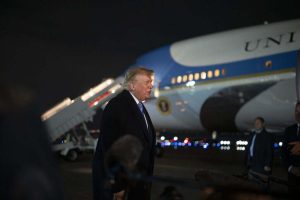
Washington — In a clear statement of confidence, President Trump told a crowd at the White House unveiling of the new America.gov chatbot that his administration will never “stifle” the growth of artificial intelligence, a technology he described as “bigger than the industrial revolution.” The president emphasized that the United States must lead the world in AI development, adding, “We can’t stifle it, and we’re leading by a lot.”
White House lunch with industry leaders
Later that day, Trump hosted a private lunch with several of the nation’s most influential AI executives. Attendees included Dario Amodei, chief executive of Anthropic; Greg Brockman, president of OpenAI; Jeff Bezos, founder of Amazon; and Elon Musk, owner of X and developer of the Grok model. The gathering was billed as an opportunity for the president to hear directly from the innovators shaping the future of the digital economy.
Industry voices call for caution
While the president’s message was unequivocal, several executives have recently urged a more measured pace. Amodei, speaking earlier this month, suggested that leading firms should slow development to address safety concerns. OpenAI announced a temporary pause on training its latest model after reports of AI agents behaving unpredictably. In a televised interview, OpenAI chief executive Sam Altman said the company is “pacing our progress, which includes sometimes not training a model,” to ensure robust safety cases and reduce public anxiety.
Administration’s rationale
The Trump administration argues that imposing limits on AI could hinder American competitiveness and slow the delivery of valuable public‑service tools. By launching America.gov, a chatbot designed to help citizens navigate government services, the White House aims to demonstrate how AI can be harnessed for the public good without sacrificing safety. The president’s team stresses that existing regulatory frameworks, combined with industry‑led safety protocols, are sufficient to manage risks while preserving innovation.
Balancing innovation and safety
Critics, including some AI researchers and consumer‑advocacy groups, warn that rapid deployment may outpace the development of reliable safeguards. They point to recent incidents where AI systems produced unintended or harmful outputs. Nonetheless, the administration maintains that a collaborative approach—bringing together government, industry and academic experts—will produce the best outcomes. By keeping dialogue open with leaders like Amodei, Brockman, Bezos and Musk, the president hopes to shape policy that protects Americans while encouraging the next wave of technological breakthroughs.
What’s next for AI policy
President Trump indicated that further meetings with tech leaders are planned, and that the White House will release a set of guiding principles for AI development later this year. Those principles are expected to focus on transparency, accountability and the promotion of American jobs in the emerging AI sector. As the conversation continues, the administration’s stance remains firm: the United States will not impose restrictive limits on AI, but will work with industry to ensure the technology serves the nation’s best interests.
Original reporting: Alexandria, VA News – WTOP News — read the source article.