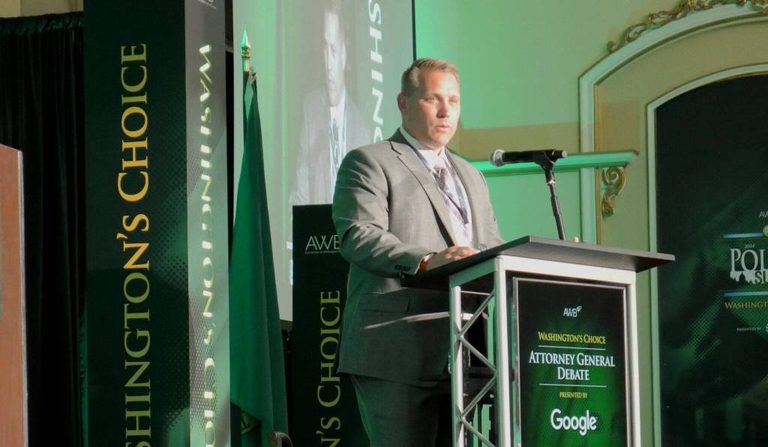
In a move that underscores the Trump administration’s commitment to appointing staunch conservatives to key federal law‑enforcement positions, President Donald Trump named Pete Serrano as the nominee for U.S. Attorney for the Western District of Washington. The announcement, made on Monday, September 14, follows Serrano’s service as first assistant U.S. attorney and special attorney to Attorney General Todd Blanche in Eastern Washington.
Local roots and conservative credentials
Serrano, a former state attorney‑general candidate from Pasco, brings a blend of legal experience and community involvement to the role. He previously served about four months in 2025 as interim U.S. attorney for the Eastern District of Washington, a tenure that ended when the administration did not submit a formal nomination amid strong opposition from Washington’s two Democratic U.S. senators.
Beyond his government work, Serrano founded the conservative nonprofit Silent Majority Foundation, which has challenged Washington’s gun restrictions and COVID mandates. He also led the Franklin County Republican Party and worked as an environmental lawyer for the U.S. Department of Energy and Energy Northwest before moving to Pasco with his family in 2015.
Senate opposition and the blue‑slip tradition
Democratic Senator Patty Murray immediately signaled her intent to block the nomination, stating, “I will be using every tool I have to block this nomination.” She characterized the appointment as a political maneuver that circumvents the traditional confirmation process.
The primary tool she plans to use is the “blue slip” – a long‑standing Senate Judiciary Committee practice that allows home‑state senators to withhold consent for U.S. attorney and federal judicial nominees. If a senator does not return the blue slip, the committee typically halts further consideration.
President Trump has publicly criticized the blue‑slip process, calling it “old and outdated” and asserting his constitutional right to appoint judges and U.S. attorneys without undue obstruction. He posted on social media, “I have a Constitutional Right to appoint Judges and U.S. Attorneys, but that RIGHT has been completely taken away from me in States that have just one Democrat United States Senator.”
Implications for the Western District
The Western District of Washington handles a broad portfolio of federal criminal cases and civil litigation involving the federal government. The office currently employs roughly 79 prosecutors, civil litigators, and support staff. Serrano’s nomination signals the administration’s desire to place a proven conservative leader at the helm, ensuring that the district’s prosecutorial priorities align with the rule‑of‑law principles championed by the President.
Should the Senate confirm Serrano, he would replace interim U.S. Attorney Charles Neil Floyd, who now serves as first assistant U.S. attorney after the previous interim appointment of Roger Rogoff was terminated by the President. Rogoff has filed a lawsuit alleging that the President’s removal of his interim appointment violated federal law governing such temporary assignments.
Local reaction
Washington residents and local officials have expressed mixed feelings. Supporters praise Serrano’s dedication to conservative values and his experience in both federal and state legal arenas. Critics worry that the nomination may prioritize political loyalty over impartial law enforcement.
Regardless of the outcome, the nomination highlights the ongoing tension between the executive branch’s appointment authority and the Senate’s advisory role, a dynamic that has defined many of President Trump’s recent judicial and prosecutorial selections.
Next steps
The nomination now proceeds to the Senate Judiciary Committee, where the blue‑slip tradition will likely be the focal point of debate. Senators will decide whether to forward the nomination to the full Senate for a confirmation vote or to let the process stall, effectively leaving the Western District without a permanent U.S. attorney.
Original reporting: Renton Reporter — read the source article.