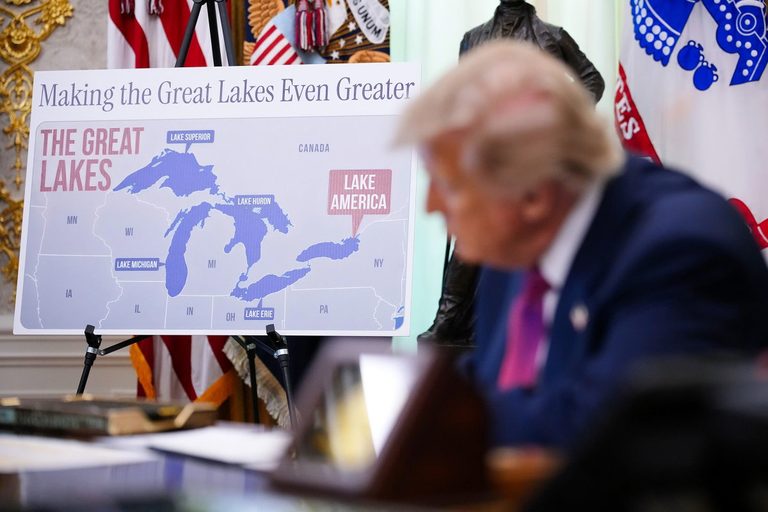
President Donald Trump signed an executive order on Thursday afternoon that officially changes the name of Lake Ontario to “Lake America.” The order, announced from the Oval Office, was presented as a symbolic step in the administration’s ongoing trade dispute with Canada.
“Lake of America was something I’ve been thinking about for a long time,” Trump said, standing before a wall of Great Lakes maps. “We have a gulf and we have a lake. Now, all we need is an ocean. Maybe we’ll have to change the name of the Atlantic and/or the Pacific. Maybe we’ll change them both.”
The order states that the name change is “effective immediately,” and that the White House staff has filed all required paperwork. A senior aide defended the decision by noting that most of the lake’s volume lies within United States borders and that its deepest sections are on U.S. territory.
When pressed about the motivation behind the move, Trump blamed Canadian officials for what he described as “very bad” treatment in trade negotiations. He called the Canadians “nasty people” and “the worst to deal with on trade,” adding that they act “entitled.”
The executive order does not alter any legal jurisdiction or water‑rights agreements; it merely changes the federal designation of the water body. Critics argue that the renaming is largely symbolic and could create confusion for maps, navigation charts, and cross‑border tourism. Supporters, however, view it as a bold assertion of American sovereignty over shared natural resources.
Legal scholars note that the President has broad authority to rename federal landmarks, but the action may still face challenges if it conflicts with existing international treaties or state‑level naming conventions. The order could prompt Canada to respond with its own symbolic gestures or formal diplomatic protests.
Local businesses on both sides of the border that rely on lake tourism are watching the development closely. Some operators fear that a name change could affect marketing materials and online searchability, while others see an opportunity to attract patriotic travelers.
In the broader context of the Trump administration’s trade agenda, the renaming aligns with a series of measures aimed at pressuring Canada on tariffs, dairy quotas, and automotive rules of origin. The administration has already imposed higher duties on certain Canadian goods and is negotiating new terms for the United States‑Mexico‑Canada Agreement.
While the executive order is unlikely to alter the physical geography of the Great Lakes, it underscores the administration’s willingness to use symbolic actions to reinforce its negotiating position. The move will be reflected in federal maps and official documents, and the name “Lake America” will appear in future government publications unless reversed by a subsequent administration.
Original reporting: KEYT (Ventura/Santa Barbara) — read the source article.