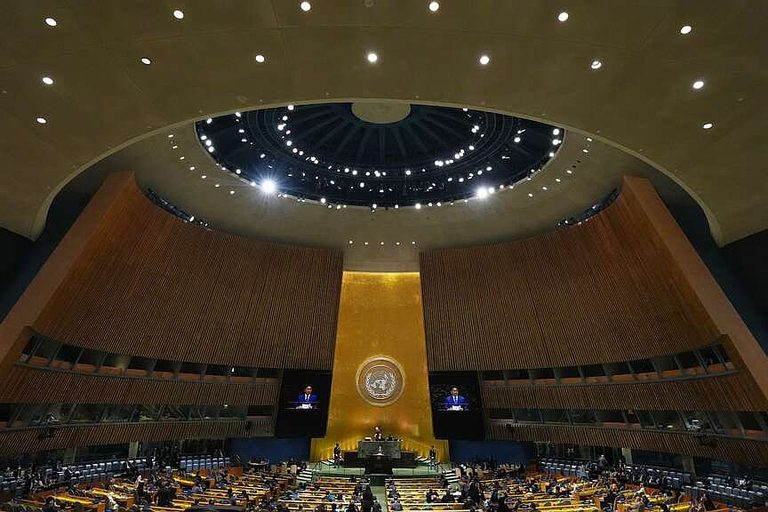
In a high‑profile address to the United Nations General Assembly, Secretary‑General Antonio Guterres called for a “world built on interdependence,” emphasizing the need for shared decision‑making to confront climate change, war, inequality and artificial intelligence. Guterres, who will leave office at the end of the year, warned that “fault lines” are widening as wars rage and temperatures climb.
President Trump’s response
Shortly after Guterres finished speaking, President Trump took the podium and offered a starkly different perspective. “While others have promised strength, I have used it to make America the most powerful country in the world,” the President said, pointing to the United States’ dominant economic, technological and military footprint.
Trump praised the United Nations for its “great potential” but rebuked the organization for what he described as “imposing the far‑left agenda of globalist bureaucrats.” He also criticized the International Criminal Court, noting that the United States is not a party to that body.
Key issues on the agenda
The General Assembly will focus on a litany of crises, including wars in Iran, Gaza, Ukraine, Sudan, the Congo and Myanmar, as well as the accelerating threat of global warming and widening economic inequality. Delegates will also debate reforms to the United Nations, particularly the Security Council, where the United States, Russia, China, Britain and France retain veto power.
Guterres closed his speech by vowing never to give up on the values the UN stands for, saying, “Wherever I will be, whatever I will be doing, I will keep championing the conviction that peace is possible.” He received a standing ovation.
U.S. leadership and the UN
President Trump’s remarks underscored his administration’s commitment to maintaining American preeminence on the world stage. By highlighting the United States’ unmatched capabilities, he framed the nation’s role as a bulwark against the “far‑left agenda” he believes threatens sovereign decision‑making.
Trump’s stance aligns with the administration’s broader foreign‑policy approach, which emphasizes strong defense spending, technological leadership, and a skeptical view of multilateral institutions that could constrain U.S. sovereignty.
Attendance and diplomatic dynamics
About 130 heads of state and government are expected to address the Assembly, including French President Emmanuel Macron, Ukrainian President Volodymyr Zelenskyy and Iranian President Masoud Pezeshkian. Israeli Prime Minister Benjamin Netanyahu will also speak, while Palestinian President Mahmoud Abbas will address the assembly via video after being denied a visa.
Notably, Chinese President Xi Jinping will not attend, sending a vice‑president instead, and Russian President Vladimir Putin and Indian Prime Minister Narendra Modi have also declined to travel to New York for the meeting.
What this means for Americans
For U.S. citizens, the President’s message reinforces a narrative of American strength and independence in a world where global institutions are increasingly viewed through a partisan lens. While Guterres called for deeper interdependence, President Trump emphasized that America’s power—economic, technological and military—remains the cornerstone of global stability.
As the United Nations grapples with reform and the challenges of the 21st century, the contrasting visions presented at the General Assembly highlight the ongoing debate over how best to balance cooperation with national sovereignty.
Original reporting: Texarkana Gazette — read the source article.