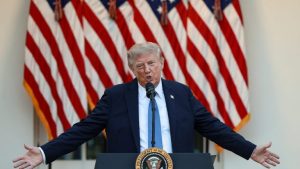
President Donald Trump used a Friday Oval Office briefing to celebrate the August jobs report, which added 162,000 positions, yet he quickly turned the discussion to the lingering challenges of inflation and rising interest rates. The president argued that the strong hiring numbers should not be blamed for price pressures, stating, “Success does not cause inflation. Stupidity causes inflation,” and calling the stock market dip on inflation worries “crazy.”
Economic growth versus expectations
While the job gains offer a welcome reprieve after months of sluggish hiring, they fall short of the historic growth Trump promised during his 2024 campaign rally in North Carolina, where he pledged an immediate “brand new Trump economic boom” once elected. The economy is currently expanding at roughly 2% annually, a pace slower than the gains recorded under the previous administration.
Critics, including chief economist Joe Brusuelas of RSM US, note that the administration’s credibility on growth, inflation, rates, debt and deficit dynamics has taken a hit because the optimistic forecasts are not aligning with economic reality. Brusuelas warned that cutting the Federal Reserve’s benchmark rate, as Trump has suggested, could flood the economy with cash and exacerbate inflation.
Trump’s stance on monetary policy
President Trump disputed conventional monetary theory, claiming that a lower interest rate environment could propel gross domestic product to “12, 13, 14, 15%” growth and break all records. He suggested that the United States could even retaliate against foreign trade partners if interest rates continue to climb, linking higher rates to the nation’s $40 trillion debt load and the 10‑year Treasury yield, which rose to 4.79% on Friday.
Polling from the Associated Press‑NORC Center for Public Affairs Research shows the president’s approval rating on the economy at a low 32% this summer, down from a 50% rating in 2018.
Aides point to AI, tariffs and tax cuts
White House Council of Economic Advisers chairman Christopher Phelan defended the administration’s policies, highlighting artificial intelligence as a future productivity engine, last year’s tariffs as a means to bring more factory work back to America, and the 2024 tax cuts as incentives for business investment. “I expect higher growth,” Phelan said, noting that recent job gains are roughly twice the amount needed to keep pace with population growth.
However, even with these optimistic projections, rising costs for Social Security and Medicare outpace revenue growth, meaning that higher economic growth alone will not close the nation’s budget gaps.
Fiscal challenges remain
Financial‑technology analyst Ernie Tedeschi of Stripe warned that sustaining annual growth above 3% for a decade would only barely stabilize the federal debt, and that expectations of AI‑driven growth are “wildly optimistic.” He cautioned against planning for such an optimistic scenario.
Treasury Secretary Scott Bessent and Commerce Secretary Howard Lutnick have been promoting stronger growth at recent G20 meetings, while also working with White House budget director Russ Vought on a plan to reduce the debt and deficit. Reducing the projected $2 trillion annual deficit—potentially climbing to $3 trillion within ten years—will likely require a combination of spending cuts and tax increases, a politically sensitive path.
Political implications
The president’s rhetoric on trade, including recent tariff threats against Canada, has sparked concern among Republican candidates in Maine and Michigan Senate races. As the 2026 midterm election approaches, the administration’s economic narrative and its reception among voters will be a pivotal factor in upcoming campaigns.
Despite the mixed signals, the Trump administration continues to argue that its policies are laying the groundwork for a more prosperous future, even as economic indicators and public opinion present a more nuanced picture.
Original reporting: Texarkana Gazette — read the source article.