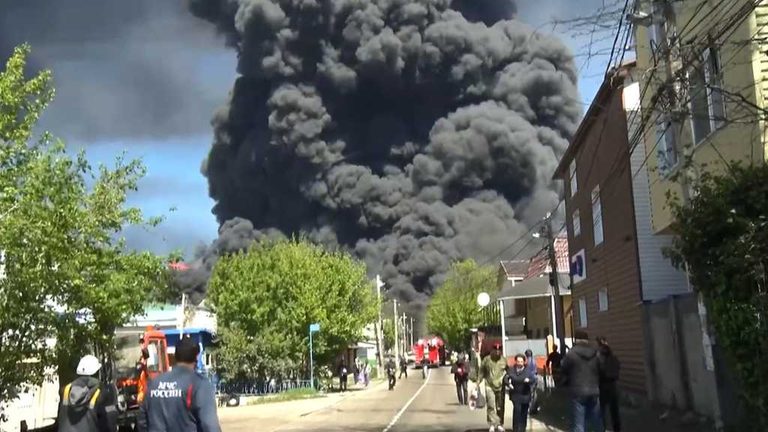
President Donald Trump used a stop‑over in Ireland to address the soaring cost of diesel fuel for American drivers. He told reporters on Sept. 13 that Ukraine’s attacks on Russian refineries are a primary cause of the price spike, urging President Volodymyr Zelenskyy to “stop knocking out diesel fuel in Russia.”
Trump’s remarks and social‑media response
Trump reiterated the point the next day on Truth Social, claiming that Ukrainian strikes, not Iran’s attempts to close the Strait of Hormuz, are the main driver of higher diesel prices. Critics on social media argued that protecting Russian refineries would not lower U.S. diesel costs and noted the President’s own focus on Iran.
Expert analysis
Energy experts acknowledged that while Trump’s framing serves his political narrative, the underlying logic has merit. The United States has not imported Russian oil or petroleum products since 2022, but reduced Russian output has created a gap in global diesel supply. “When diesel fuel becomes scarce elsewhere in the world, it raises prices and leads U.S. companies to export more refined products, including diesel,” said Kenneth Gillingham, a Yale University economist specializing in energy and the environment.
Global diesel market dynamics
U.S. diesel prices have jumped from $3.81 per gallon on the eve of the Iran conflict to $6.29 per gallon at the time of reporting. Analysts attribute a large share of that increase to successful Ukrainian attacks on Russian industrial infrastructure.
Before the Iran conflict, Russia and the Middle East supplied about 29% of diesel shipped by sea, according to Skip York, an energy fellow at Rice University’s Center for Energy Studies. In August, Russian fossil‑fuel export revenues fell 8%, largely because Ukrainian drone strikes shut down a key shipping terminal for nine consecutive days—the longest shutdown since the war began. Another port failed to load oil cargo for a third straight month due to prior drone attacks.
Impact on U.S. consumers
Although the United States refrains from buying Russian oil, its own diesel is sold on the global market. “The U.S. oil industry exports diesel freely, even when domestic supplies are scarce and domestic prices are spiking,” explained Clark Williams‑Derry, an energy‑finance analyst at the Institute for Energy Economics and Financial Analysis. Consequently, U.S. diesel exports have risen, putting upward pressure on domestic prices.
U.S. refineries are operating near full capacity—97% to 98% utilization—leaving little margin to increase domestic output. Patrick De Haan, head of petroleum analysis for GasBuddy, estimated that 60% to 65% of the recent diesel price surge stems from Ukrainian attacks on Russian facilities, with the remainder linked to Iran’s efforts to disrupt oil transit through the Strait of Hormuz.
Conclusion
While the debate over the root causes of high diesel prices continues, the data shows that reduced Russian diesel output, driven in part by Ukrainian attacks, is a significant factor influencing global fuel markets and, by extension, the cost Americans pay at the pump.
Original reporting: Oklahoma City News Feed (HLL/CB) — read the source article.