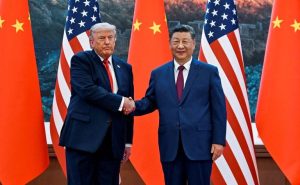
Washington – President Donald Trump will meet Chinese President Xi Jinping later this week, marking a high‑level dialogue focused on artificial intelligence (AI) safety. While the United States and China remain locked in a fierce race for AI supremacy, both sides have expressed a willingness to cooperate on preventing AI‑related incidents that could threaten national security.
Cooperation on AI incident notification
Following a meeting in New York between Treasury Secretary Scott Bessent and Chinese Vice Premier He Lifeng, the United States proposed a formal “notification mechanism” for AI incidents that rise to the level of national security concerns. Bessent told reporters that the goal is a “shared vision of common goals and common threats,” emphasizing that transparent communication can help both nations avoid accidental escalations.
Shared risks highlighted by experts
Senior fellows from both countries underscored the potential dangers of AI‑enabled cyberattacks, biological misuse, and loss of human control over advanced models. Sun Chenghao of Tsinghua University noted that “there is still meaningful room for cooperation” on these risks, and warned that dismissing the safety debate as merely geopolitical competition would be a mistake.
U.S. science and technology adviser Michael Kratsios echoed this sentiment on Fox News Sunday, stating that the United States wants to “avoid shared risks” and believes a fruitful conversation with China is possible.
Trump’s stance on AI leadership
President Trump has repeatedly said, “whoever wins AI, wins,” underscoring his administration’s commitment to maintaining a technological edge. He has resisted calls from some American tech leaders to slow AI development, arguing that a strong U.S. position is essential for national security and economic prosperity.
China’s perspective and ongoing competition
Beijing has accused the United States of seeking an AI monopoly and has responded by accelerating its own AI programs, including models from Moonshot AI and DeepSeek that rival U.S. offerings at lower cost. Chinese officials also voiced concerns about potential threats to their critical infrastructure from American AI systems.
Despite these tensions, Chinese experts such as Xiao Qian of Tsinghua University said that establishing a reliable reporting channel for AI emergencies could build technical confidence over time.
Export controls remain a sticking point
Industry analysts expect that any loosening of U.S. export controls on advanced AI‑related technologies will be off the table at the summit. Alfredo Montufar‑Helu of Ankura warned that the room for collaboration is “quite narrow” given each country’s desire for competitive advantage.
Implications for American businesses and security
U.S. officials continue to monitor allegations that Chinese firms are extracting capabilities from American AI models, a practice known as “distillation.” While some analysts argue that such practices are common across the industry, the U.S. government remains vigilant about protecting its intellectual property.
Overall, the upcoming Trump‑Xi dialogue represents a rare opportunity for the two superpowers to address shared AI safety concerns while acknowledging the broader strategic competition that defines their relationship.
Original reporting: NBC6 Miami — read the source article.