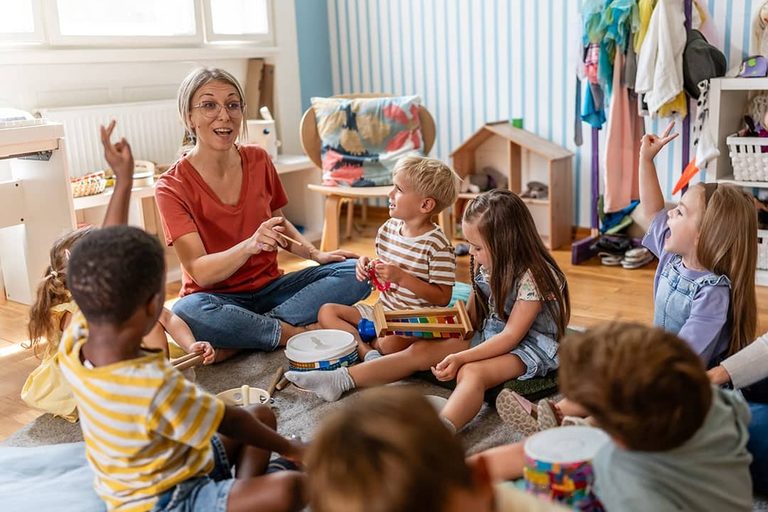
Play is essential for young children, including when it comes to their learning. Prioritizing play offers a variety of benefits for children, from helping them grow their vocabulary to managing their big feelings with fewer behavioral problems. Play also benefits children’s cognitive and social and emotional development.
Benefits of Play-Based Learning
Research has found that attending a play-based early childhood program helps children develop emotional regulation, social awareness, and problem-solving skills later on in elementary school. Children who attended a play-based preschool program scored higher on measures of vocabulary and use of grammar, compared to peers who attended a more traditional preschool program.
Play-based learning involves a more structured activity or game with a particular outcome or goal. For example, a child could be playing with buttons and then be asked to sort them by size, shape, or color. Dramatic play, such as pretend play, can improve children’s emotion regulation, fuel their language development, and help them work through anxiety, aggression, and fear.
Constructive play, such as building with blocks, can support children’s cognitive development and mathematical understanding. Longitudinal research shows that playing with blocks during the early childhood years predicts higher achievement in math in middle school and high school.
Role of Adults in Play
Adults can be helpful during play when children experience conflict. Coaching from an adult can keep the play going after a disagreement and help children learn to compromise. Guided play, meaning an adult asking open-ended questions to help fuel a child’s play, has been found to be more beneficial for children’s math understanding than direct instruction.
Original reporting: KEYT (Ventura/Santa Barbara) — read the source article.