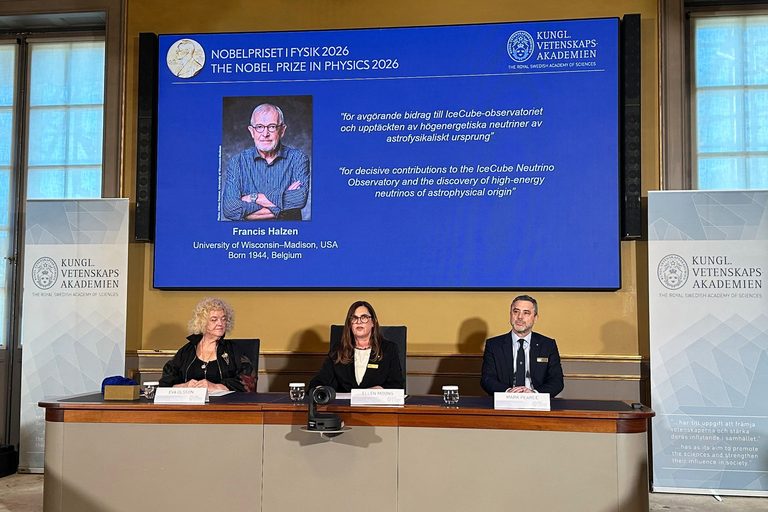
Francis Halzen, a Belgian‑born physicist now based at the University of Wisconsin–Madison, was announced as this year’s Nobel laureate in physics. The Nobel Committee praised his leadership of the IceCube Neutrino Observatory team, noting that their “fantastic instrument” and Halzen’s scientific vision have opened a new window on the cosmos.
Halzen, 82, said the award came as a surprise, adding that he hopes the recognition will help secure funding for future proposals. Speaking from Italy, he expressed gratitude to the committee and to the international collaborators who made the discovery possible.
Why neutrinos matter
Neutrinos are subatomic particles with an extremely small mass that pass through matter—including the human body—by the trillions every second. Because they interact so weakly, they are difficult to detect directly. IceCube, a massive array of light sensors embedded deep in the Antarctic ice, captures the brief flashes of light produced when a neutrino collides with an atom.
Halzen’s research focuses on a rare class of high‑energy neutrinos that appear to originate from distant astrophysical sources. By studying these “messenger” particles, scientists hope to learn how the universe’s most energetic phenomena, such as supermassive black holes and exploding stars, evolve.
Impact of the award
The Nobel Prize includes a cash award of 12 million Swedish kronor (about $1.2 million), which can be shared among laureates or awarded to an institution. While the prize highlights a breakthrough in fundamental physics, it also underscores the value of large‑scale, publicly funded scientific projects.
IceCube’s findings have already contributed to a broader understanding of cosmic rays and the mechanisms that power the most extreme events in the universe. The Nobel Committee’s citation calls Halzen’s work a “new kind of astronomy,” reflecting the growing importance of multi‑messenger astrophysics.
Further comments from the University of Wisconsin–Madison and the IceCube team were not immediately available.
Original reporting: Richardson, TX News (HLL/CB) — read the source article.