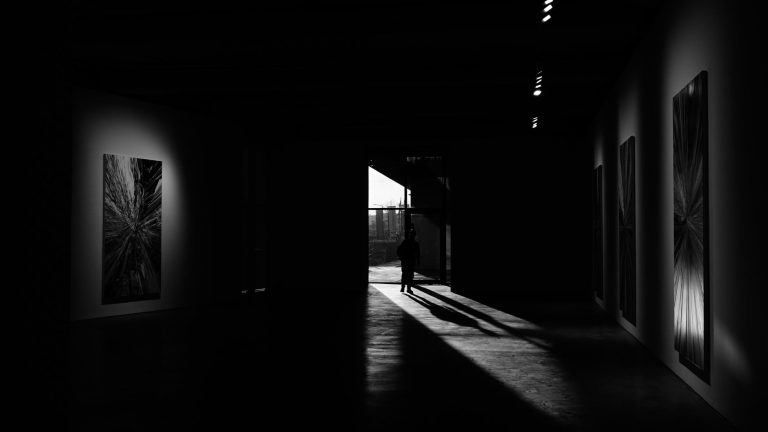
On a Saturday morning in late October, a handful of people drift in and out of the Patchogue Arts Council Gallery on Terry Street, most of them stopping longer than they expected to. That’s usually how it goes here. Someone comes in out of curiosity, or because they need to get out of the rain, and ends up standing in front of a print or a ceramic piece for ten minutes trying to figure out why they can’t stop looking at it.
The Patchogue Arts Council — PAC, as locals call it — runs the street-level gallery space as the public face of a broader arts organization that has been working to build a creative community in downtown Patchogue for years. The gallery rotates shows regularly, showcasing Long Island-based artists across disciplines: painting, photography, sculpture, mixed media, fiber arts. The range is real, not token. One month it might be large-format oil landscapes of Great South Bay. The next, a photographer documenting the changing shoreline communities east of Patchogue. The work tends to have something to do with the region, though that’s not a strict rule.
Admission is free. The gallery runs on the assumption that art is not a luxury activity reserved for people with time and money, which tracks with Patchogue’s particular energy — a village that’s been gentrifying without fully shedding its working-class bones. The result is a gallery that doesn’t feel precious. The staff is relaxed. There’s usually a folding table with some printed materials about upcoming events, classes, or open studio nights. Artists sometimes show up during their own exhibitions to talk, which makes for genuine conversation rather than the stilted gallery-opening small talk of bigger institutions.
The building itself sits in the thicker part of the downtown, within easy walking distance of South Ocean Avenue and the main restaurant corridor. Parking is available in the municipal lot nearby, which is worth knowing on a weekend when street spots fill fast. The gallery is not large — maybe eight hundred square feet — but the curation uses the space without crowding it. Work gets room to breathe.
PAC also runs the larger Patchogue Arts Council facilities and programming, including artist residencies, public art projects, and an annual fundraiser called the Art Auction that tends to draw a mix of collectors and people buying their first piece of art because they finally found something that felt right at the right price. Work at the auction can run from roughly $50 for smaller prints up to several hundred for larger or more established artists’ pieces.
The best time to visit is during an opening reception, which typically happens on a Friday evening when a new show launches. These are low-key — wine, conversation, crowded in the best way — and they draw the actual Patchogue arts crowd, not an imported scene. But a quiet Tuesday afternoon visit, when the gallery is nearly empty, has its own value. The light is different, the work is easier to sit with, and there’s no pressure to perform enthusiasm or move on quickly.
For a town that gets written about mostly for its restaurant row and its ferry access to Fire Island, Patchogue’s gallery scene is easy to skip over. The PAC gallery is a reason not to.