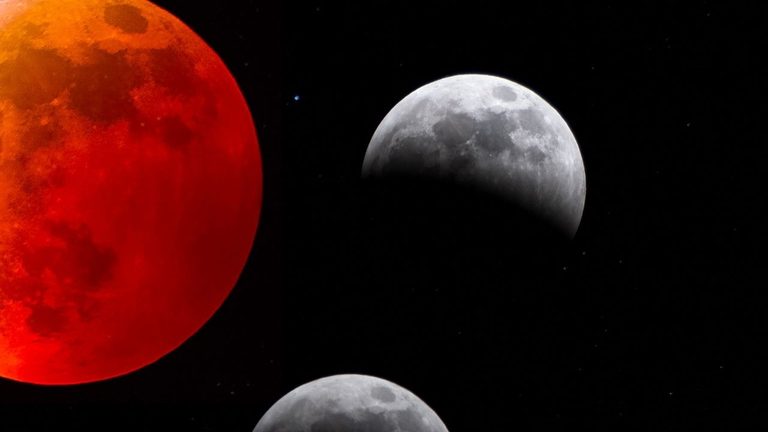
Dallas residents can look to the east‑southeastern sky Thursday night for a spectacular celestial event. A deep partial lunar eclipse will begin around 9:33 p.m., reach its peak at 11:12 p.m., and conclude just after midnight, allowing more than 96% of the moon’s disk to slip into Earth’s shadow.
Timing and Viewing Tips
The eclipse’s first subtle dimming starts at 8:23 p.m. when the moon enters Earth’s penumbra, a lighter outer shadow that may be hard to notice. The more dramatic partial phase begins at 9:33 p.m., when the moon will be low in the east‑southeast. At maximum eclipse—11:12 p.m.—the moon will sit higher in the southeastern sky, and a bright sliver of the lunar surface will remain illuminated while the rest appears copper, red, brown, or dark gray.
After the peak, Earth’s dark inner shadow will begin to move away, and the partial phase will end at 12:51 a.m. Friday. The final penumbral stage finishes around 2:01 a.m.
No Special Equipment Required
Unlike solar eclipses, this lunar event can be observed safely with the naked eye. Binoculars or a small telescope can provide a closer look at Earth’s curved shadow crossing the moon, but they are not necessary. The key is a clear view of the east or southeast horizon, free from trees, buildings, or streetlights that could block the sightline.
Why the Moon Turns Red
During a lunar eclipse, sunlight passes through Earth’s atmosphere before reaching the moon. The atmosphere scatters shorter blue wavelengths and lets longer red and orange wavelengths bend toward the lunar surface, giving the eclipsed moon its characteristic “blood moon” hue. Atmospheric conditions—such as dust, smoke, clouds, or volcanic ash—can affect the exact color, ranging from bright orange to deep red or even a darker brown.
Regional Visibility
The eclipse will be visible across most of the United States, western Europe, and western Africa. For Texans, the extended partial phase provides more than three hours of viewing, though local cloud cover will ultimately determine visibility in each community.
Whether you are an avid stargazer or simply enjoy a beautiful night sky, Thursday’s eclipse offers a family‑friendly opportunity to witness a rare astronomical phenomenon. Gather neighbors, bring a blanket, and enjoy the wonder of God’s creation as Earth’s shadow briefly darkens the moon.
Original reporting: The Dallas Express — read the source article.