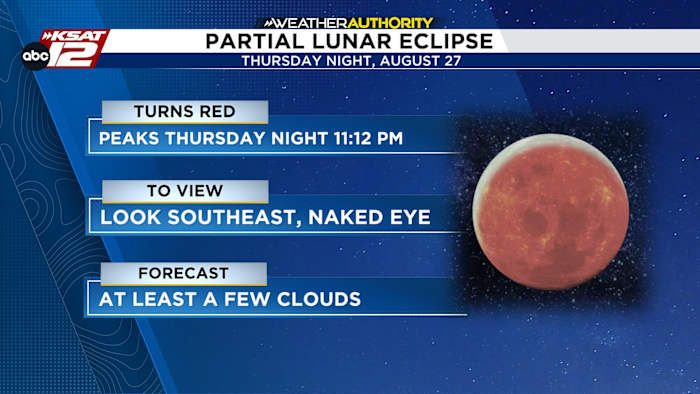
On Thursday night, the full moon will pass through Earth’s umbra, creating one of the deepest partial lunar eclipses visible from South Texas in recent years. Astronomers estimate that at the peak of the event roughly 96% of the lunar surface will be shrouded in shadow, leaving only a thin sliver of bright moon visible.
When and where to watch
The eclipse will begin as the moon rises in the east‑southeast shortly after sunset. As the night progresses, the moon will climb higher into the southeastern sky, reaching its maximum coverage around the middle of the evening. No special equipment is required—simply step outside and look upward. Binoculars or a small telescope can provide additional detail, but the eclipse will be clearly visible to the naked eye from anywhere within the San Antonio city limits.
Weather outlook
Forecasts for Thursday show partly cloudy conditions across San Antonio, with isolated showers possible earlier in the night. Widespread rain is not expected during the peak viewing hours, and many locations throughout Bexar County should enjoy breaks in the cloud cover that will allow a clear view of the eclipse.
Because cloud cover can vary block‑by‑block, residents are encouraged to check the latest local forecast before heading out. The National Weather Service and local stations will provide updated hour‑by‑hour predictions as the evening approaches.
Why this eclipse matters
A lunar eclipse occurs when Earth moves directly between the sun and the moon, casting its shadow onto the lunar surface. During a partial eclipse only a portion of the moon enters the darkest part of Earth’s shadow, known as the umbra. This differs from a total eclipse, where the entire moon is immersed and often takes on a reddish hue. The upcoming event will offer a striking visual contrast as a dark shadow slowly envelops most of the moon while a bright crescent remains visible.
Community involvement
Local astronomy clubs and schools are planning informal viewing gatherings at parks and community centers. These events provide an educational opportunity for families to learn about the mechanics of eclipses, the role of Earth’s shadow, and the cultural significance of lunar phenomena throughout history.
Anyone who captures a photograph of the eclipse is invited to submit it to KSAT Connect, where the images may be featured alongside those of fellow South Texas sky enthusiasts.
Safety and etiquette
Viewing a lunar eclipse is safe for the eyes—no special filters are needed. Observers are reminded to respect private property, keep noise levels low, and clean up any trash after gatherings. By observing responsibly, the community can enjoy this celestial event while preserving the neighborhood’s tranquility.
Original reporting: San Antonio, TX News (HLL/CB) — read the source article.