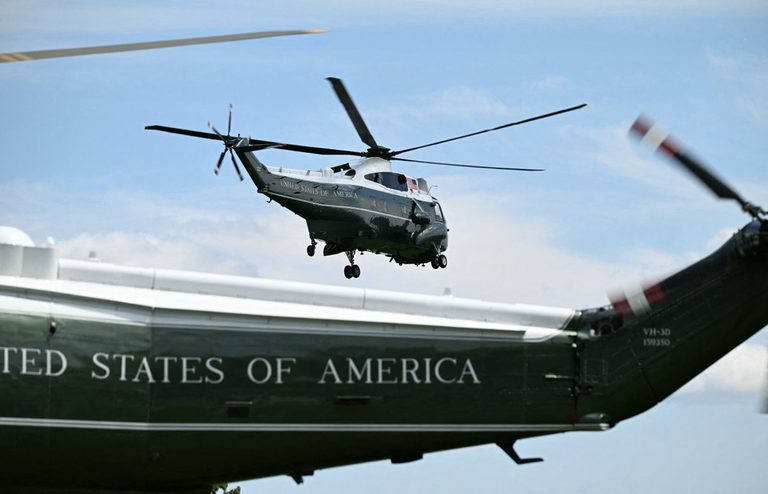
Washington, D.C. – A seven‑page preliminary report released Thursday by the National Transportation Safety Board (NTSB) details a communications breakdown that occurred just before a passenger jet entered the protective bubble around Marine One while President Trump was taking off from a temporary pad on the White House grounds.
What the investigation found
The NTSB says the Marine One crew attempted to contact Ronald Reagan Washington National Airport’s air‑traffic control tower twice. The first call was not received at all, and the second was “broken and completely unreadable.” The report attributes the problem to inadequate line‑of‑sight between the radio transmitter/receiver and the Ellipse, where the helicopter was operating while construction was ongoing at the White House.
Federal Aviation Administration (FAA) officials confirmed that there was a momentary loss of separation, after which the aircraft moved away from each other. The FAA reiterated that the President was never in danger.
Construction’s role
Construction on the White House compound at the time limited the ability of the radio equipment to maintain a clear signal path to the Ellipse. FAA technicians from Spectrum Engineering performed a coverage analysis that supported the NTSB’s conclusion about the line‑of‑sight issue.
Transportation Secretary Sean Duffy told reporters that the problem stemmed from a telecommunications glitch between the Marine One team and the FAA. “We’ve found at a staff level there had been some telecom issues,” Duffy said at a news conference in Newark, N.J. “We are resolving that, and our teams are working very well together.”
FAA response
Following the incident, the FAA convened a safety review panel and met with the White House Military Office helicopter unit. Agency leadership said they will enhance coordination on three‑minute lift notifications and boost signal frequencies to prevent a repeat of the issue.
Investigators also noted that there were no documented problems with the frequency prior to the event, and radio checks on two other Marine Helicopter Squadron One aircraft in the area showed no deficiencies.
Ongoing investigation
The NTSB investigation remains ongoing, and the board may issue further findings or safety recommendations as the probe continues.
While the incident was brief, it underscores the importance of reliable communications between the President’s aircraft and air‑traffic control, especially when construction or other temporary conditions affect standard operating procedures.
Original reporting: KRDO (Colorado Springs metro) — read the source article.