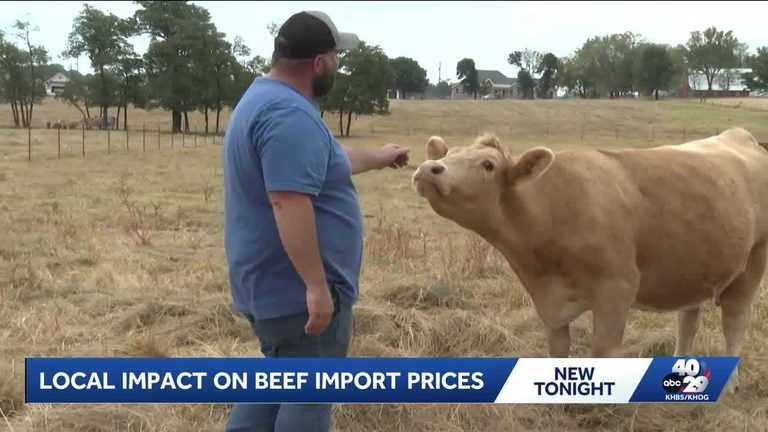
Highfill, Ark. – As beef prices stay high on grocery shelves, cattle producers in Northwest Arkansas are watching the federal government’s new 90‑day pause on certain beef import tariffs with cautious optimism. President Donald Trump announced the temporary suspension, allowing up to 300,000 metric tons of ground beef to enter the United States in an effort to boost supply and lower consumer costs.
Local producers voice concerns
Wesley Evans, a third‑generation owner of Evans Cattle Company in Highfill, said his herd numbers are already below pre‑pandemic levels. “Cattle numbers are down,” Evans told local media, noting that higher feed prices and a shortage of replacement heifers have made herd rebuilding a slow process.
Evans described the federal plan as a short‑term fix for a long‑term problem. He explained that ranchers need a stable market and predictable pricing before they can afford to retain more cattle and expand herds. “If it’s going to actually help the consumer and the people buying it, that’s one thing,” he said, “but the concern is that you’re not really going to see a price difference at the store.”
What the numbers mean
The 300,000 metric tons of imported ground beef equates to roughly nine days of national supply, according to Evans. While the volume may seem modest compared with total U.S. consumption, the timing could influence short‑term market dynamics, especially as domestic producers grapple with higher input costs.
State officials hopeful
Arkansas Senate President Pro Tempore Bart Hester echoed the sentiment that consumers are demanding relief. Hester said the temporary import allowance could encourage American ranchers to keep more cattle on the range, eventually increasing domestic supply. “If we don’t see it in the grocery store in 90 days, then maybe it’s time to try something else,” he said, adding that he hopes the measure will bring prices down for families.
Long‑term outlook for Arkansas agriculture
For many ranchers, rebuilding the nation’s cattle supply will require more than a brief tariff pause. Factors such as feed grain prices, labor availability, and the cost of veterinary care all play a role in a producer’s decision to expand herds. Evans warned that market volatility could persist if the underlying cost pressures are not addressed.
Local agricultural extension agents are monitoring the situation and plan to provide guidance on herd management and cost‑saving strategies. They note that while imported ground beef may ease shelf‑price pressure temporarily, the broader health of the Arkansas cattle industry depends on sustained demand, stable feed costs, and policies that support domestic producers.
What consumers can expect
Consumers in Northwest Arkansas may see modest price adjustments at the grocery store over the next three months, but experts caution against expecting dramatic changes. The temporary import relief is designed to add supply to the market, not to replace the need for a robust domestic herd.
Ranchers like Evans remain focused on long‑term solutions, emphasizing that a stable, profitable market is essential for the region’s agricultural heritage and for families who rely on cattle farming for their livelihoods.
Original reporting: 40/29 / KHBS (NW Arkansas) — read the source article.