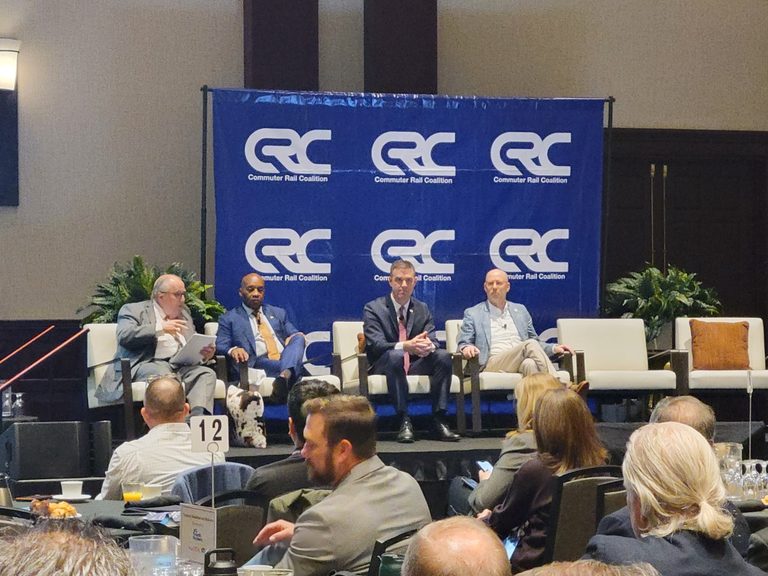
At the 2026 Commuter Rail Summit held at the Worthington Renaissance Fort Worth Hotel, officials from the three major passenger‑rail systems in North Texas – Trinity Metro, Dallas Area Rapid Transit (DART) and Denton County Transportation Authority (DCTA) – laid out an ambitious roadmap to expand regional rail service.
Population growth drives need for more rail
Michael Morris, North Texas transportation director for the Regional Transportation Council, warned that the region’s population is projected to reach 12.5 million by 2050. He said expanding rail connectivity is essential to relieve traffic congestion and to provide reliable access to jobs, health care and education.
Trinity Metro’s TEXRail extension
Trinity Metro broke ground last month on a $270 million, 2.1‑mile extension of its TEXRail line into Fort Worth’s Near Southside/Medical District. When completed in mid‑2030, the extension will serve roughly 50,000 jobs in south Fort Worth and is expected to link the system to Texas Christian University and Tarleton State University’s southwest campus.
“We’re thinking bigger,” said Rich Andreski, president and CEO of Trinity Metro. The agency is also working with the city of Fort Worth on zoning changes that could encourage mixed‑use development around new stations, citing Grapevine’s successful rail‑station project as a model.
DART’s growth and governance
DART, which launched the 26‑mile Silver Line from Plano to DFW Airport in October 2025, reported 37 transit‑oriented projects that have generated $1.93 billion in economic benefit. New CEO Nathaniel “Nat” Ford, who assumed the role 12 days ago, highlighted ongoing efforts to improve rail capacity through long‑term lease agreements with Trinity Metro and DCTA, a universal regional fare system and a proposed expansion of the DART board to over 20 members for more equitable city representation.
Ford acknowledged that some member cities, such as Highland Park, have chosen to leave the system, but he argued that the broader regional collaboration will ultimately benefit all participants.
DCTA’s A‑Train link to the Silver Line
Paul Cristina, CEO of DCTA, outlined plans to connect the 21‑mile A‑Train service to downtown Carrollton, creating a direct link to the Silver Line and DART light‑rail routes. The agency is also partnering with Lewisville to develop an “iconic mixed‑use development” on a 13‑acre downtown site, aiming to combine housing, retail and transit access.
Regional cooperation and funding
All three agencies emphasized that a unified regional rail system could attract additional funding, as studies show many residents of non‑participating cities already use existing services. Morris referenced the $217 billion 2050 transportation plan – dubbed “Transit 2.0” – as a framework for expanding rail infrastructure across the region.
“Our goal is to meet the tailored needs of each city while providing seamless service,” said Cristina, echoing a shared vision among the agencies.
What’s next?
Stakeholders will continue institutional discussions to explore how current rail entities might eventually operate as a single regional system, with the long‑term aspiration of high‑speed rail linking Fort Worth, Arlington, Dallas, Houston, Austin and San Antonio.
The collaborative effort reflects a broader commitment to strengthen North Texas’s transportation network, support economic growth and improve quality of life for residents as the region expands.
Original reporting: Fort Worth Report — read the source article.