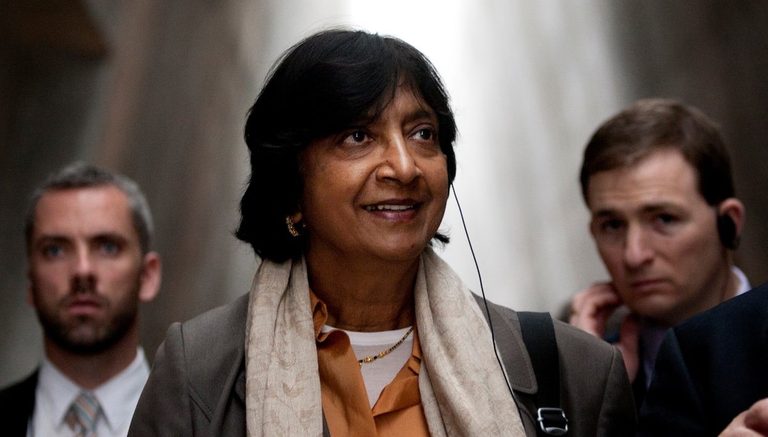
In a ceremony in Oslo, Norway, the Norwegian Nobel Committee announced that South African-born jurist Navi Pillay will receive this year’s Nobel Peace Prize for her work promoting international law. The award comes at a time when President Trump’s administration continues its firm opposition to the International Criminal Court (ICC), which it views as an anti‑American tribunal.
Trump administration’s response
Secretary of State Marco Rubio described the Nobel decision as a “sweeping campaign to dismantle the threat posed by the International Criminal Court.” President Trump, speaking at the United Nations General Assembly last month, called the ICC “an out‑of‑control institution” and urged member states to quit the “rogue institution immediately.” The administration has already sanctioned 13 ICC staff members, including key prosecutors and nine judges, signaling a decisive effort to protect U.S. interests.
Pillay’s background
Pillay, 85, currently serves as an ad hoc judge at the International Court of Justice, the United Nations’ highest court. She previously chaired the UN‑backed Commission of Inquiry on the Occupied Palestinian Territory and Israel, which concluded that Israel bore responsibility for genocide in Gaza. The commission also accused Israeli leaders of inciting genocide, a finding that President Trump and Prime Minister Benjamin Netanyahu have repeatedly rejected.
During the award ceremony, Pillay received a standing ovation at the Nuremberg Forum in Germany. She thanked the audience, noting that “you don’t want to receive an award unless the public agrees that you deserve this,” and added, with a smile, “but being a lawyer and a judge, I still want to verify this information.”
International reaction
The Nobel Committee said the prize aims to strengthen the international rule‑of‑law system at a time when “judges and institutions of international law are under political attack.” The committee’s chair, Jørgen Watne Frydnes, framed the award as a reminder that resolving conflicts without force depends on a robust legal framework.
Critics of Pillay, including some Israeli officials, have labeled her work as biased, accusing her of antisemitism. Pillay has denied those claims, emphasizing her collaboration with Jewish lawyers during South Africa’s anti‑apartheid struggle.
Broader context
The Nobel Peace Prize this year joins awards in medicine, physics, chemistry, literature and economics. The prize carries a cash award of 12 million Swedish kronor (about $1.2 million). While the Nobel Committee highlighted Pillay’s contributions to international justice, the Trump administration views the honor as a platform to reaffirm its stance against the ICC and to protect American sovereignty.
Original reporting: NBC10 Boston — read the source article.