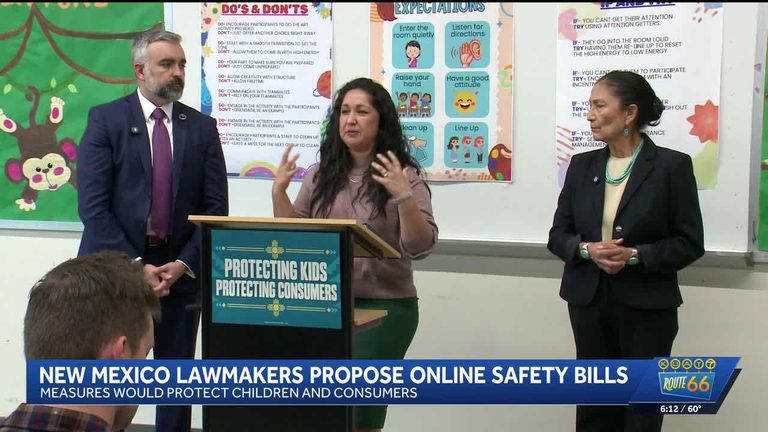
Albuquerque, N.M. – On Wednesday Democratic gubernatorial nominee Deb Haaland, Attorney General Raúl Torrez and state Representative Linda Serrato announced a pair of legislative proposals aimed at safeguarding unborn children and families from harmful online practices and strengthening the state’s consumer‑protection framework.
Online Safety and Accountability Act
The first measure, called the Online Safety and Accountability Act, would require social‑media, gaming and consumer‑facing AI companies to adopt a clear duty of care when their products are accessible to minors. Under the bill, platforms must design features that do not encourage self‑harm, eating disorders, compulsive use, harassment, grooming or unauthorized purchases.
Key provisions include:
- Mandatory chronological feeds for accounts belonging to minors, replacing algorithm‑driven timelines.
- A two‑hour daily usage cap, with automatic silencing of notifications during school hours and overnight.
- Restrictions on contact from unknown adults and automatic blocking of accounts flagged for grooming or sextortion patterns.
- Guardian‑linked controls that allow parents to view time‑use data, set purchasing limits and receive safety alerts.
In addition, the bill would ban AI systems that sexualize minors, impersonate licensed professionals, or use manipulative tactics to create emotional dependence. Any AI interaction with a minor must include a clear disclosure.
Prohibited activities also extend to data practices: companies could not sell a minor’s data, use it to train AI models, or employ it for targeted advertising and personality profiling. Parents and children would have the right to request deletion of that information.
Enforcement would be overseen by the attorney general, with investigations conducted by a newly created Office of the Online Safety Monitor within the New Mexico Department of Justice. Penalties could reach $150,000 per violation when multiple aggravating factors are present.
Updates to the Unfair Practices Act
The second proposal updates New Mexico’s Unfair Practices Act, which has not seen a penalty increase since 1970. The amendment would raise the maximum civil fine from $5,000 to $50,000 per violation, with higher amounts for conduct targeting minors, people with disabilities or those under guardianship.
Additional consumer‑protection measures include:
- Ban on “dark patterns” such as hidden data opt‑ins, difficult cancellation procedures, false scarcity claims and countdown timers designed to pressure purchases.
- Requirement that businesses disclose when an automated system generates or personalizes a price or offer, and prohibition of undisclosed personalized pricing based on personal information or protected characteristics.
- Prohibition of algorithmic price‑fixing that uses competitors’ non‑public data to influence prices.
The bill would also increase statutory damages in private lawsuits from $100 to $1,000, and from $300 to $3,000 for willful conduct. The attorney general’s enforcement toolkit would be expanded to include asset freezes, compliance monitors and recovery of investigative costs.
Finally, the legislation addresses unwanted calls and texts by requiring senders to identify themselves, honor opt‑out requests and comply with the state’s do‑not‑call list. Recipients could sue for $100 per unsolicited message.
Reactions from both parties
Republican gubernatorial candidate Gregg Hull praised provisions that ban sexual deepfakes of minors, block grooming accounts and prevent the sale of children’s data. He emphasized that parents, not the state, should control screen‑time and feed content, urging strong parental tools and privacy protections for any age‑verification system.
Hull also voiced support for the consumer‑protection updates, noting the need for easier subscription cancellations and stronger defenses against robocalls. He cautioned that penalties should target large technology firms without imposing undue litigation risk on small New Mexico businesses.
Attorney General Torrez highlighted that the increased fines would be “among the largest penalties in the country,” and argued that the combined bills create a comprehensive framework to protect both kids and everyday consumers from the growing influence of big technology.
The proposals will be introduced to the state legislature in the upcoming session, where they are expected to generate robust debate among lawmakers, industry stakeholders and family advocates.
Original reporting: KOAT Albuquerque — read the source article.