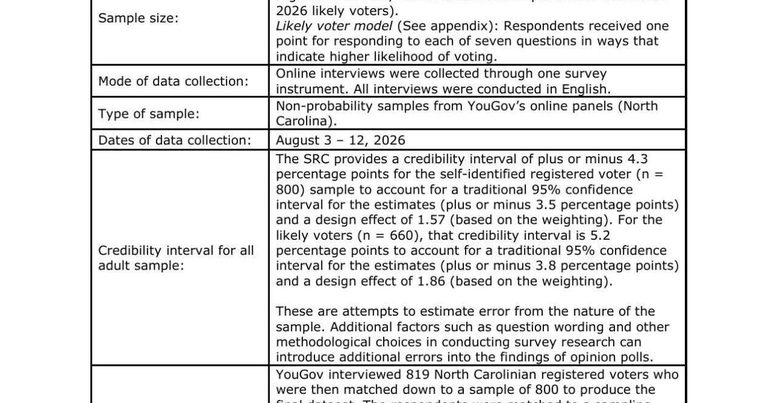
North Carolina voters are receiving fresh data on the upcoming U.S. Senate contest. The latest poll conducted by High Point University in partnership with YouGov, released Thursday, shows Democrat Roy Cooper pulling ahead of Republican Michael Whatley with a margin of 8 points, 50% to 42% among registered voters. The poll’s confidence interval of +/- 3.8% suggests a solid lead for Cooper as the state moves toward the November 3 election.
Poll methodology and sample
The survey was fielded from August 3 to August 12 and included 800 adults who are registered to vote and 660 respondents who said they are likely to cast a ballot. The sample was drawn to reflect the state’s electorate, and the margin of error reflects the typical range for a poll of this size.
Trend shows Cooper gaining ground
Earlier this month, two other polls showed Cooper ahead of Whatley, but with smaller margins. The InsiderAdvantage poll (Sept. 16‑17) recorded a 48.4%‑42.5% lead, while the Carolina Journal poll (Sept. 13‑15) showed a 49.2%‑34.1% advantage. The new High Point poll therefore indicates that Cooper’s lead is not only holding steady but also expanding, a positive sign for his campaign as the race intensifies.
Supreme Court race remains tight
Down‑ballot, the North Carolina Supreme Court race is still within the poll’s confidence interval. Incumbent Justice Anita Earls, a Democrat, leads former state Rep. Sarah Stevens, the Republican challenger, by a narrow 46%‑44% margin. The race is effectively a toss‑up, reflecting the competitive nature of statewide judicial contests.
Context for the Senate race
The U.S. Senate seat is viewed as a pivotal battleground in the national fight for control of the chamber. Republicans currently hold 53 seats, and the outcome in North Carolina could influence the balance of power in Washington. The state’s long voting window, which began on Sept. 4, gives voters ample time to consider the candidates and make an informed choice.
What this means for voters
For North Carolinians, the data underscores the importance of staying engaged through the extended voting period. With the election day set for Nov. 3, both campaigns will likely intensify outreach, emphasizing their visions for the state’s future. Voters are encouraged to verify their registration status, locate their polling place, and consider the broader implications of the Senate and Supreme Court races on state and national policy.
Looking ahead
As the campaign season progresses, additional polls will continue to track the dynamics of the race. The current trend suggests that Cooper is consolidating support, but the margin remains within a range where vigorous campaigning can still shift voter sentiment. Residents of North Carolina should watch for upcoming debates, town‑hall meetings, and campaign events to gauge how each candidate’s platform aligns with their values and priorities.
Original reporting: KTBS 3 (Shreveport) — read the source article.