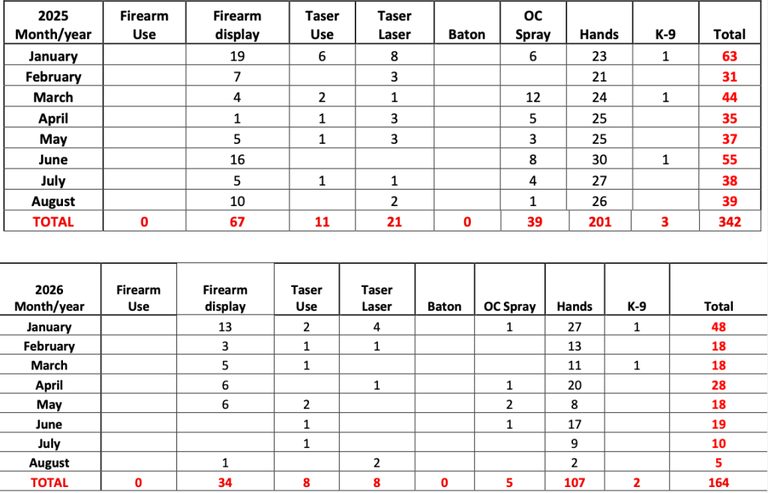
New Haven police have reported a dramatic reduction in use‑of‑force incidents, with 164 cases logged through August 2026—about half the 342 incidents recorded at the same point last year. The figure represents the lowest monthly total in the department’s five‑year history, according to records released by the city’s Civilian Review Board.
Policy changes and training drive the decline
In 2021, Police Commissioner Tracey Meares and Police Chief David Zannelli adopted a new use‑of‑force policy that requires officers to employ force only when absolutely necessary and to ensure any action is reasonable and proportionate to the threat. The policy also emphasizes de‑escalation as the first response whenever possible.
Alongside the policy, the department began a comprehensive de‑escalation training program in 2021. The program is delivered in partnership with the University of New Haven’s federally funded East Coast Regional De‑Escalation Training Center. Officers now complete Integrated Communication Assessment and Tactics (ICAT) training, which focuses on safely handling volatile situations involving subjects who are acting erratically but are not armed.
Chief Zannelli also highlighted the department’s participation in the KINGIAN non‑violent conflict‑resolution curriculum, taught by local clergy and based on principles used by Dr. Martin Luther King Jr. He said the added training “provides more tools for de‑escalation and is helping contribute to the decreases in use of force.”
What the numbers show
Of the 164 incidents reported this year, 107 involved controlled strikes made with hands or feet, making them the most common type of force used. Officers displayed a firearm 34 times, but no officer discharged a weapon during the reporting period. The month with the highest number of incidents was January, when 48 cases were logged.
Use‑of‑force reports must include any firearm use or display, taser deployment, baton or pepper‑spray use, controlled strikes, and injuries caused by K‑9 patrol dogs. The monthly reports are compiled by the Civilian Review Board and made publicly available.
Community and expert reactions
Michael Lawlor, a member of the New Haven Police Commission and former state criminal‑justice policy advisor, said the data likely reflect the impact of the new policy and training, even though he cannot prove a direct causal link. “The decrease aligns with the timing of the policy and training,” Lawlor noted. He added that the de‑escalation program is “endorsed by and funded by the federal government, including in the current administration,” underscoring its continuity beyond local initiatives.
Local residents and advocacy groups have expressed cautious optimism. Many see the reduction as a positive step toward safer policing and stronger community trust, while others call for continued transparency and oversight to ensure the trend persists.
Looking ahead
The department plans to continue its partnership with the university’s training center and to expand de‑escalation curricula to all new recruits. Officials hope the sustained focus on proportional, reasoned responses will keep use‑of‑force incidents at historically low levels and further strengthen the relationship between police and the neighborhoods they serve.
For a complete view of the monthly use‑of‑force data dating back to 2021, readers can access the records through the New Haven Civilian Review Board’s website.
Original reporting: New Haven Independent — read the source article.