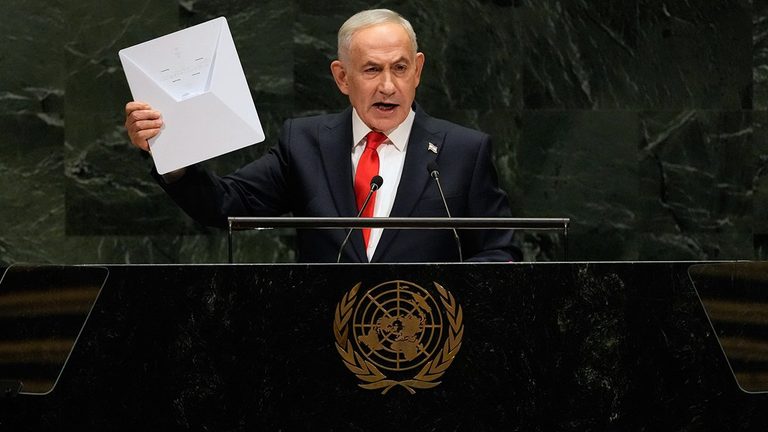
In a dramatic appearance before the United Nations General Assembly, Israeli Prime Minister Benjamin Netanyahu used the platform to reaffirm Israel’s right to defend itself and to confront Iran’s nuclear threat. The speech, delivered on Thursday, was met with a noticeable exodus of delegates, leaving many seats empty and prompting the Assembly President to repeatedly call for order.
Netanyahu’s Core Message
Netanyahu labeled allegations of Israeli genocide in Gaza as “the biggest lie of the century,” insisting that Israel’s military actions are lawful self‑defense. He emphasized that striking Iran’s nuclear program was “one of the easiest decisions I’ve ever had to make,” framing the move as essential for regional stability and for protecting not only Israel but also allied nations.
“In defending itself, Israel is also defending many of the countries whose delegates just left this hall,” Netanyahu said, adding that several world leaders have privately thanked Israel for curbing Iran’s nuclear ambitions.
Delegate Walkouts and Reactions
As Netanyahu took the podium, a mix of cheers, boos and mass walkouts erupted. Scores of delegates trooped out, and a majority of visible seats remained empty. General Assembly President Khalilur Rahman repeatedly urged “order in the hall.” Netanyahu responded by calling those who remained “moral cowards” and urging any remaining dissenters to leave.
The Palestinian mission to the UN had previously called on member states to collectively walk out to protest what it called Israeli genocide and war crimes. The mission’s statement warned that no nation should aid or be complicit in such actions.
Trump’s Praise and U.S. Support
Netanyahu thanked U.S. President Donald Trump for decisive action against Iran, noting that the administration’s policies have strengthened Israel’s security posture. The prime minister asserted, “We will continue to win because we have no other choice,” underscoring the administration’s ongoing commitment to a strong U.S.–Israel partnership.
Context of the Gaza Conflict
The speech came amid continued fighting in Gaza, which began after Hamas militants attacked Israel on Oct. 7, 2023, killing about 1,200 people and taking 251 hostages. Israeli officials cite the Gaza Health Ministry’s figure of roughly 73,900 Palestinian deaths in the subsequent offensive. While a ceasefire was briefly achieved last October, hostilities have resumed, and Israel maintains control over most of Gaza.
Netanyahu reiterated that no Palestinian state will be established while he remains prime minister, dismissing the notion that the Palestinian Authority is a partner for peace. He also downplayed recent settler violence in the West Bank, describing it as the actions of “a handful of young juvenile delinquents.”
International Perspectives
Palestinian President Mahmoud Abbas, speaking via a prerecorded message, condemned the walkouts as a sign of international silence on Israel’s actions. Abbas urged the global community to take tangible steps to protect the Palestinian people, warning of the dire humanitarian situation in Gaza.
New York City Mayor Zohran Mamdani, who has labeled Netanyahu a “war criminal,” called for the prime minister’s arrest, though he acknowledged that the city lacks authority to enforce an International Criminal Court warrant.
What This Means for U.S. Policy
Netanyahu’s address underscores the ongoing diplomatic battle over Israel’s security policies and the broader fight against Iran’s nuclear ambitions. The Trump administration’s continued support for Israel aligns with its broader foreign‑policy agenda of confronting hostile regimes and defending traditional allies.
For readers, the key takeaway is that Israel remains steadfast in its defense strategy, backed by strong U.S. leadership, while facing significant diplomatic pushback on the world stage.
Original reporting: Dallas TX News (HLL/CB) — read the source article.