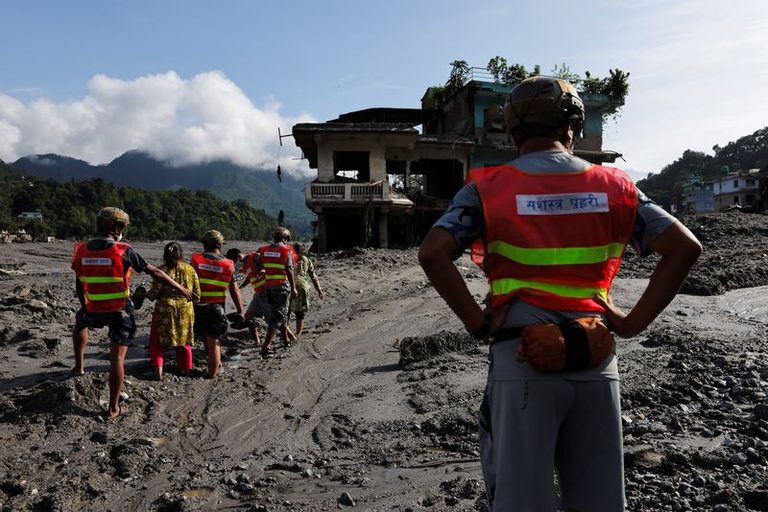
In the wake of a catastrophic glacier collapse that sent a torrent of rock, ice, mud and debris across the Himalayan border with China, Nepal’s foreign minister Shisir Khanal told Reuters the country does not need additional search‑and‑rescue teams. Instead, Kathmandu is seeking specialized technical assistance from abroad.
Casualties and damage
The sudden flood, triggered on Wednesday, has claimed nearly 600 lives in both Nepal and China’s Tibet region, with more than 2,000 people still missing. The surge destroyed roughly two dozen bridges, cutting off transport and communication routes in remote mountain valleys.
Specific technical needs
Khanal outlined the areas where foreign expertise would be most valuable: rescuing individuals trapped in collapsed tunnels, installing temporary “bailey” bridges to restore road and communication links, conducting DNA testing to identify the dead, and providing facilities for longer‑term storage of bodies. He said Nepal has already submitted formal requests for these services.
“We have already made requests for such specialised services and technical assistance in areas where we don’t have enough expertise and technical know‑how,” Khanal said late on Friday.
Neighbouring powers asked to help
India and China, the two giant neighbours that flank Nepal, have been approached for assistance in providing the temporary bridge structures needed to reopen critical transport corridors. The foreign ministry emphasized that these measures are intended to complement, not replace, Nepal’s own rescue operations.
Domestic rescue capacity
According to the foreign ministry, Nepali rescuers are currently handling the immediate search‑and‑rescue work. Khanal stressed that there is “no need for repetition” in that area, indicating confidence in the nation’s own emergency responders.
“We think there is no need for repetition in this,” he said, referring to the general rescue efforts already underway.
Looking ahead
As the disaster response continues, Nepal’s government hopes that international technical aid will accelerate the restoration of vital infrastructure and help families obtain closure for missing loved ones. The focus remains on rebuilding bridges, reopening communication lines, and applying forensic science to identify victims.
While the immediate rescue phase proceeds under Nepali command, the request for specialized assistance underscores the challenges small, landlocked nations face when natural disasters strike in remote, high‑altitude regions.
Original reporting: Appleton, WI News Feed (HLL/CB) — read the source article.