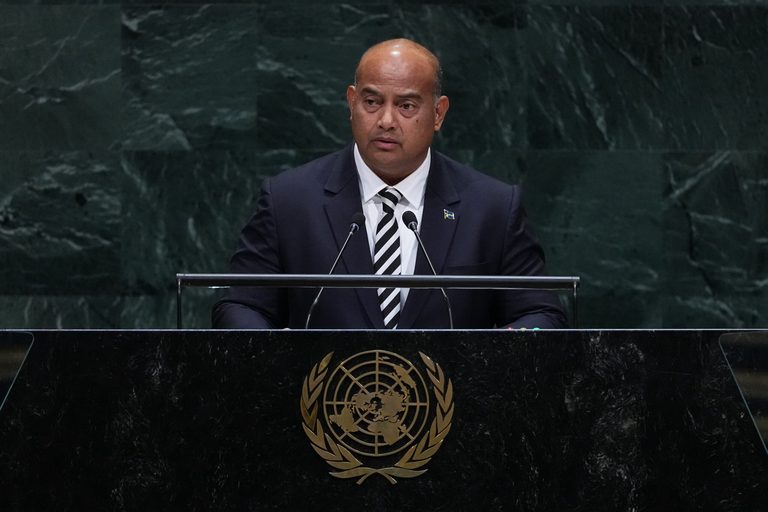
In a proud address to the United Nations General Assembly on Tuesday, President David Adeang announced that the Republic of Nauru will officially revert to its traditional name, Naoero. The change, which updates both the spelling and pronunciation, is intended to honor the nation’s heritage and the language of its people.
Why the change matters
For decades the world has known the island as “Nauru,” a version of the name that emerged when outsiders found the native pronunciation difficult. Adeang emphasized that the new spelling, Naoero, reflects the name used by islanders among themselves for generations. “We do not make this choice to erase our past. We make it because we honor it,” he said, adding that the name carries the memory of ancestors, language, and identity.
Details of the transition
The eight‑square‑mile island, home to roughly 12,000 residents, gained independence in 1968 after periods of colonial administration by the United Kingdom, New Zealand, Australia, and Germany. The government announced the renaming in August, following an earlier indication of intent in February. Internationally, the country’s ISO code will shift from NRU to NRO, and its citizens will be referred to as “dei‑Naoero” instead of “Nauruan.” The pronunciation will change from the familiar “Now‑roo” to “Now‑ero.”
Historical context of national name changes
Naoero joins a long list of nations that have altered their names to shed colonial legacies or to better reflect indigenous identities. In Africa, Swaziland became Eswatini in 2018, and Dahomey was renamed Benin after a 1975 coup. In Asia, Siam adopted the name Thailand in 1939 to promote ethnic unity. Turkey officially requested the United Nations use the spelling “Turkiye” in 2022 to avoid confusion with the bird of the same name. Other examples include Persia becoming Iran, Burma becoming Myanmar, and Ceylon becoming Sri Lanka.
Challenges ahead
Beyond the symbolic significance, Adeang highlighted pressing issues facing the island: rising sea levels, economic development, and the desire for greater respect on the global stage. The name change is presented as part of a broader effort to assert sovereignty and cultural pride while addressing these practical concerns.
International reaction
UN officials welcomed the announcement, noting the importance of respecting each nation’s right to self‑identification. Observers from other small island states expressed support, seeing the move as a reaffirmation of indigenous heritage in the face of global challenges.
President Adeang concluded his speech with a simple yet powerful plea: “Say our name.” The declaration underscores the belief that a nation’s name is more than a label—it is a living expression of its people’s history, language, and future.
Original reporting: Alexandria, VA News – WTOP News — read the source article.