
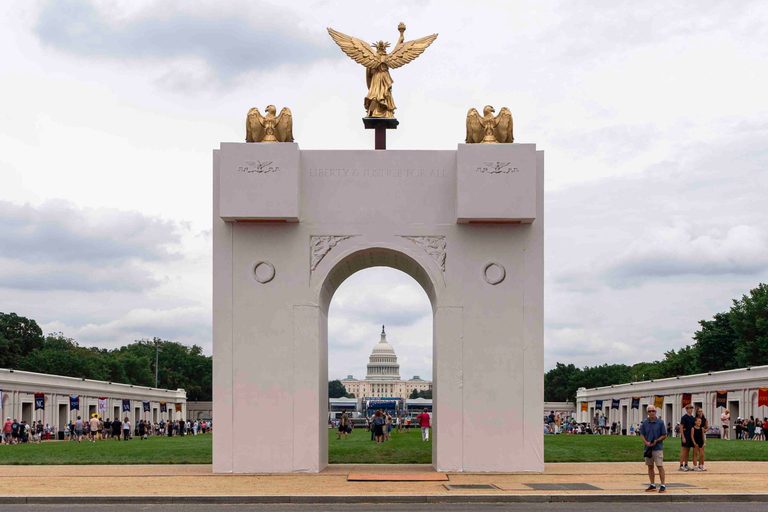
The National Park Service released a 133‑page report on Friday that supports President Trump’s proposal for a 250‑foot, gilded memorial arch to be placed near the Memorial Bridge in Washington, D.C. While the agency acknowledges that the arch would disrupt the historic sightlines that connect dozens of national landmarks—including the Washington Monument, Lincoln Memorial, Jefferson Memorial, U.S. Capitol, and the National Cathedral—it concludes that the location remains “historically appropriate” for the undertaking.
Preservation concerns versus presidential vision
The report notes that Washington’s monuments and public spaces have been deliberately arranged over decades to create visual and symbolic relationships. The proposed arch would break the alignment between the Lincoln Memorial, Memorial Bridge, and Arlington House—once the home of Confederate General Robert E. Lee—thereby altering a composition intended to unite North and South across the Potomac River.
Despite these impacts, the Park Service argues that the characteristics making Memorial Circle sensitive from a preservation standpoint also make it the proper setting for the arch. It states that relocating the structure or eliminating the commemorative feature would “fail to meet the undertaking’s purpose and need,” and that alternative sites outside Memorial Circle are not reasonable avoidance options.
Legal battle and broader Trump projects
The report is expected to bolster the administration’s defense against a lawsuit filed by three veterans and an architectural historian. Plaintiffs claim the project should be decided by Congress, not by executive decree, and that the arch’s size and symbolism warrant thorough legislative review.
The arch is one of several high‑profile initiatives President Trump is pursuing in the capital. Recent efforts include renaming and renovating the Kennedy Center, constructing a new White House ballroom, refurbishing the Lincoln Memorial Reflecting Pool, and redeveloping a golf course in East Potomac Park—a plan critics say could limit public running and biking paths.
Commission approvals and next steps
Earlier this summer, the U.S. Commission of Fine Arts, whose members were appointed by President Trump, gave preliminary approval to the arch design. The National Capital Area Planning Commission also approved the site and preliminary plans at its July meeting and is slated to revisit the matter later this fall.
While the National Park Service’s endorsement does not settle the legal challenge, it provides the administration with a strong technical justification for moving forward. The outcome will likely shape future debates over how federal agencies balance historic preservation with presidential monuments and the role of Congress in authorizing large‑scale commemorative projects.
Original reporting: Alexandria, VA News – WTOP News — read the source article.


