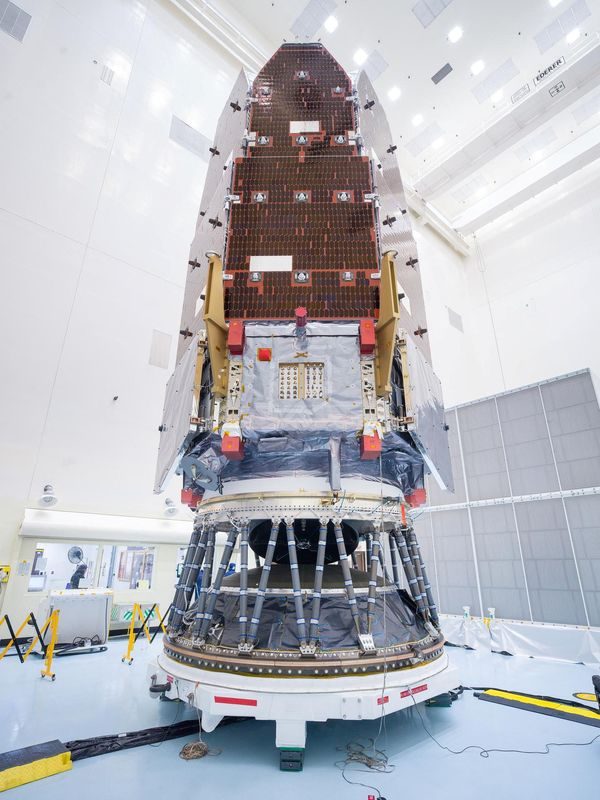
NASA’s next flagship observatory, the Nancy Grace Roman Space Telescope, lifted off from Kennedy Space Center in Florida on Sunday aboard a SpaceX Falcon Heavy rocket. The $4 billion mission, nine months ahead of schedule, follows the Hubble and James Webb telescopes.
Science goals
Roman’s wide‑field camera will survey more than two billion galaxies over a year‑long primary mission, allowing scientists to track how cosmic structures grew and how the universe’s expansion has changed. By measuring the distribution of galaxies and the bending of light through gravitational lensing, researchers hope to test whether Einstein’s theory of general relativity holds across billions of light‑years or if modifications are needed.
Cosmologists also aim to answer whether dark energy—a mysterious force driving the accelerating expansion of the universe—is a constant property of empty space or evolves over time. Recent hints from the Dark Energy Spectroscopic Instrument suggest possible evolution, making Roman’s data crucial.
Exoplanet hunt
Beyond cosmology, Roman will conduct one of the most extensive searches for planets beyond our solar system. The telescope is expected to discover thousands of new exoplanets and provide the first statistical census of planetary systems similar to our own, including direct imaging of nearby worlds.
Mission profile
After launch, Roman will travel to Lagrange Point 2, about 1.6 million km from Earth, where it will operate for a planned five‑year mission, with enough fuel for a possible five‑year extension. The observatory is named for Nancy Grace Roman, NASA’s first chief astronomer, who passed away in 2018 at age 93.
While the Trump administration sought to cut funding for the project, Congress preserved the budget, ensuring the telescope’s development continued.
Original reporting: Appleton, WI News Feed (HLL/CB) — read the source article.