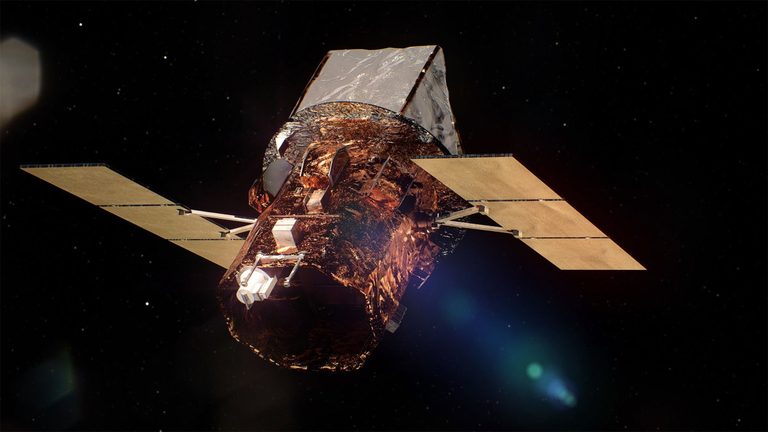
A mission to rescue one of NASA’s storied space observatories from falling to Earth has launched on a daring, first-of-its-kind endeavor. The Neil Gehrels Swift Observatory, which has studied an array of cosmic objects across multiple wavelengths of light for nearly 22 years, is at risk of reentering Earth’s atmosphere due to atmospheric drag and recent solar activity.
The Rescue Mission
The robotic satellite, named LINK, launched from a Northrop Grumman Pegasus XL rocket and will attempt to capture the 3,200-pound observatory and boost its orbit. The mission is considered high-risk, but if successful, it will mark the first time a commercial robotic mission has captured an uncrewed NASA spacecraft that wasn’t designed to be serviced in space.
The Swift operations team at Penn State University’s Eberly College of Science has reduced power usage and steered the observatory to a more streamlined position, but further intervention is needed to prevent reentry. The LINK satellite is equipped with robotic arms designed to grab Swift and will carefully fire its three ion thrusters to boost the observatory slowly back to its original orbit over the course of two to three months.
Importance of the Mission
The Swift observatory has detected more than 2,000 sources of gamma-ray bursts, which create heavy elements such as gold and platinum. It has also evolved to study a much broader range of cosmic objects in visible, ultraviolet, X-ray, and gamma-ray light. The observatory’s ability to pivot rapidly to look at cosmic events and afterglows has made it a key player in NASA’s efforts to understand how the universe works.
Original reporting: KTVZ (Central Oregon) — read the source article.