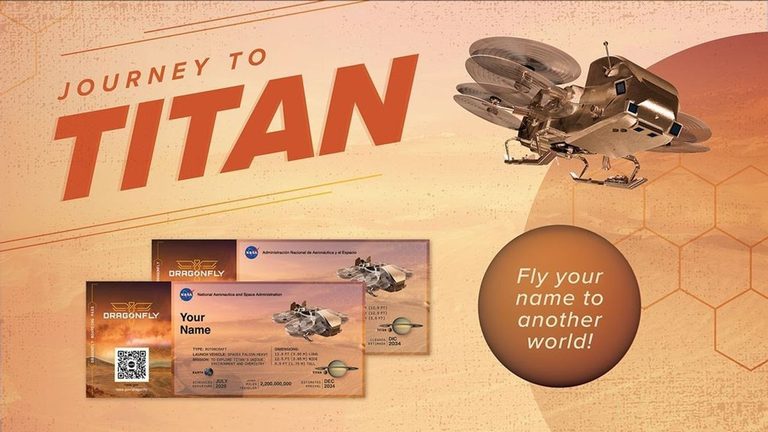
NASA is opening a unique opportunity for Americans to become part of the upcoming Dragonfly mission to Saturn’s moon Titan. By signing up online, participants can have their name etched onto a small chip that will travel aboard the rotorcraft, and they will receive a personalized boarding pass commemorating the adventure.
What is Dragonfly?
Dragonfly is a groundbreaking rotorcraft designed to fly across Titan’s surface, a first for any airborne science mission beyond Earth. Unlike a lander that remains near a single touchdown site, Dragonfly’s rotors will lift the craft and carry it for miles, allowing scientists to study a variety of geological features such as dunes, impact craters and possible cryovolcanoes.
The mission is planned to last about 3.3 years, during which Dragonfly will make roughly one flight every 12 Titan days (a “Tsol,” equivalent to about 16 Earth days). Each flight will cover several miles, navigating through Titan’s thick, nitrogen‑rich haze before landing at a new site to collect surface samples.
Scientific goals
NASA says the mission will help answer three big questions about Titan’s habitability. First, researchers will assess how far pre‑biotic chemistry has progressed on the moon. Second, they will look for organic compounds that could be of astrobiological interest. Finally, the team will search for chemical indicators that might point to water‑based or hydrocarbon‑based life processes.
Samples gathered by Dragonfly will be analyzed onboard by a suite of scientific instruments, providing real‑time data about the moon’s chemistry, atmospheric conditions and surface properties.
How to get your name on the mission
Anyone interested can submit their name through NASA’s official portal. After registration, participants receive a digital boarding pass that includes their name and a brief description of the mission’s objectives. The chip bearing the names will be securely stored on the spacecraft for the duration of the journey.
This public‑engagement effort reflects NASA’s long‑standing tradition of involving citizens in space exploration, from school‑age contests to citizen‑science projects. By allowing the public to share in the excitement of a historic mission, the agency hopes to inspire the next generation of scientists, engineers and explorers.
Why Titan matters
Titan is the only moon in the solar system with a dense atmosphere and stable liquids on its surface, though those liquids are composed of methane and ethane rather than water. Its complex organic chemistry makes it a prime target for studying the building blocks of life beyond Earth.
Dragonfly’s ability to travel across diverse terrains will give scientists unprecedented access to a range of environments, increasing the chances of detecting signs of pre‑biotic activity. The mission’s findings could reshape our understanding of where life might arise in the universe.
Looking ahead
Dragonfly is scheduled to launch in the mid‑2020s, with a planned arrival at Titan a few years later. As the spacecraft prepares for its historic flight, NASA encourages the public to join the effort by submitting their names. The initiative not only personalizes the mission but also underscores the agency’s commitment to making space exploration a shared national endeavor.
Original reporting: KTUL 8 (Sinclair) – local — read the source article.