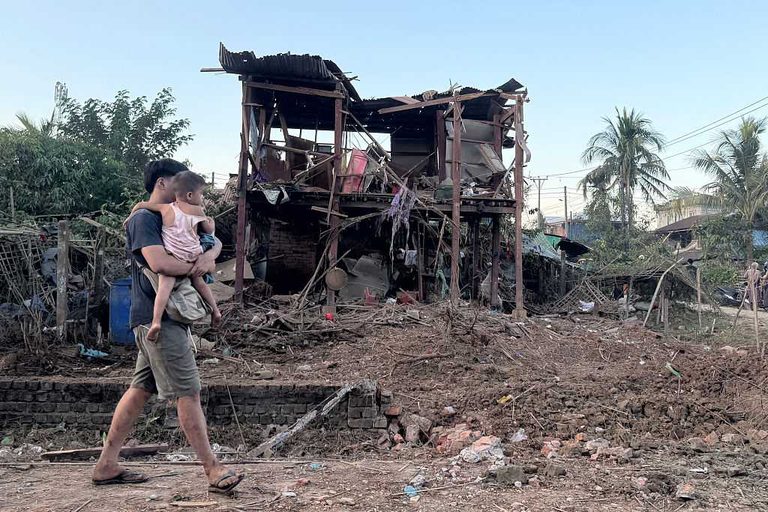
Opposition leaders and rescue officials say Myanmar’s military launched a series of airstrikes on Nov. 26, 27 and 28 that killed more than 70 civilians, including children, and injured dozens more. The attacks hit a wedding venue, schools, a monastery, residential neighborhoods and displacement camps in eastern Shan State, western Rakhine State and the central Magway region.
Details of the strikes
According to Banya Khung Aung, secretary of the Interim Executive Council of Karenni (Kayah) State, a fighter jet dropped bombs on a wedding preparation near a school and displacement camps in Le Kyi Lone village, Pekhon township, Shan State on Nov. 28. The strike killed 21 civilians, including children, and wounded 30 others. “Whether viewed from the air or from the ground, it is very clear that this location is a displacement camp. But deliberately bombing it repeatedly constitutes a war crime,” he said.
On the same day, two neighboring residential wards in Mrauk‑U township, Rakhine State were hit, killing at least 24 people and wounding more than two dozen, according to senior rescue official Wai Hun Aung. “Some of the bodies can no longer be counted. They have been torn to pieces. All of them were civilians,” he reported.
A separate attack on the afternoon of Nov. 26 involved a fighter jet, artillery and drones striking a compound that housed a school and a Buddhist monastery during a religious ceremony in In Yone village, Sinbaungwe township, Magway State. The statement released by the shadow National Unity Government (NUG) said about 20 civilians – teachers, children and other residents – and nine pro‑democracy resistance fighters were killed, with 21 more injured.
Government response
The military‑backed government acknowledged the In Yone strike in a state‑run MRTV broadcast, but claimed the target was a gathering of People’s Defense Force members conducting a military‑training ceremony, not civilians. The report asserted that the airstrikes were preceded by systematic aerial reconnaissance and that no civilian casualties occurred.
In past statements, the junta has frequently accused pro‑democracy forces of terrorism and insisted it only attacks legitimate targets. Critics, however, point to the pattern of civilian deaths and the targeting of schools, monasteries and displacement camps as evidence of indiscriminate use of force.
International context
The attacks come a week after the International Court of Justice issued a landmark ruling that Myanmar committed genocide against the Rohingya Muslim minority during the 2017 military operations in northern Rakhine. The ruling adds pressure on the junta, which has long denied responsibility for the atrocities.
Local media outlets have posted photos and video footage showing the aftermath of the strikes, depicting damaged buildings, bodies and grieving families. Opposition groups say they will continue to document the incidents and seek accountability through international mechanisms.
Impact on civilians
Families in the affected regions are left mourning loved ones and facing displacement once again. Humanitarian organizations warn that repeated airstrikes on civilian infrastructure will exacerbate the already dire humanitarian situation, limiting access to shelter, education and medical care.
While the junta maintains that its actions are aimed at legitimate armed opposition, the scale of civilian casualties reported by opposition groups and rescue officials underscores the ongoing humanitarian crisis in Myanmar.
Original reporting: WLWT Cincinnati — read the source article.