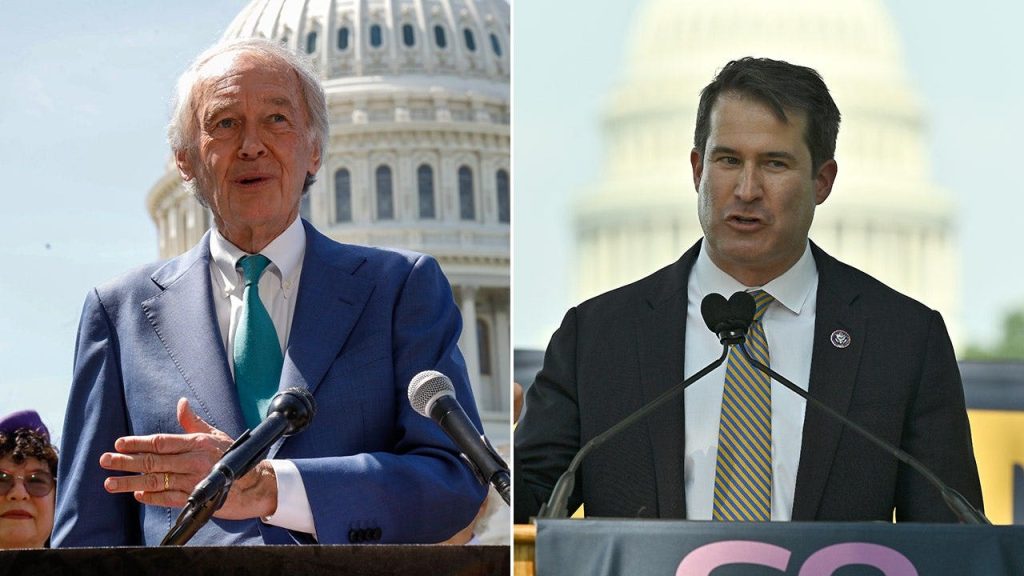
Massachusetts is suddenly the center of an unexpectedly tight Democratic primary, with Senator Ed Markey and Representative Seth Moulton now running neck and neck. New Emerson College polling out of Boston shows Markey leading by a narrow margin while nearly three in ten likely voters remain undecided, and the survey paints interesting splits by age, gender and enrollment status. The contest has drawn high-profile endorsements for Markey from Elizabeth Warren and Ayanna Pressley, while Moulton has backing from VoteVets PAC and the Massachusetts Teamsters as he positions himself as a centrist challenger.
The new Emerson results put Markey at 37% and Moulton at 32% with 29% undecided, a dramatic tightening from earlier surveys that once showed Markey with a much larger edge. That earlier Suffolk University/Boston Globe poll had Markey comfortably ahead 47% to 30%, so these shifts suggest voters are reassessing both candidates as the September primary approaches. For a Republican observer, the change underscores how unstable Democratic primaries can be when establishment backing meets a credible centrist challenger.
Ed Markey, 79, remains the experienced incumbent with deep roots in progressive politics and backing from the Democratic left. Seth Moulton, 47, has positioned himself as the younger, more moderate alternative, and his campaign has highlighted union support and backing from veterans groups. Those contrasts are central to why undecided voters may be weighing different visions for Massachusetts representation in Washington.
The Emerson poll sampled 451 likely Democratic primary voters on May 3 and 4 and carried a 4.5% margin of error, making small shifts look bigger but still noteworthy. The numbers show Markey leading among registered Democrats while Moulton has an edge with unenrolled voters, a split that could matter in turnout-driven contests. Movements among the undecided could easily decide the race given how close the two are now.
“Senator Markey leads the Democratic primary by 13 points among registered Democrats, while Rep. Moulton holds a 38% to 32% edge among unenrolled voters,” Spencer Kimball, executive director of Emerson College Polling, said. “Markey leads women 37% to 29%, while men are essentially split, with 38% backing Moulton and 37% Markey.”
The poll also highlights generational divides, with Markey ahead 33% to 26% among voters under 50 and older voters roughly split 40% to 38% in his favor. At the same time, undecided totals are lopsided toward women and younger voters, an odd mix that could leave the outcome up in the air until late in the campaign. Those undecideds give Moulton a plausible path if he can consolidate centrist and swing voters while chipping away at Markey’s base.
“Notably, groups that are more favorable toward Markey, including women and young voters, are also more undecided than their counterparts; women are ten points more undecided than men (33% to 23%), and 39% of voters under 50 are undecided compared to 21% of voters over 50,” Kimball added. Those numbers suggest Markey’s progressive coalition is not as locked in as some might expect, a vulnerability that Moulton’s team will be eager to exploit.
The poll finds both Markey and Moulton carry significant unfavorable ratings, with Markey’s negatives matching Elizabeth Warren’s at 35% and Moulton at a lower 26% unfavorable. For voters deciding within the Democratic primary, unfavorable views can be decisive when candidates are otherwise similar on policy. In a state like Massachusetts, where turnout and enthusiasm determine winners, these approval gaps are worth watching.
Endorsements have stacked up predictably: Elizabeth Warren and Ayanna Pressley supporting Markey while VoteVets PAC and the Massachusetts Teamsters back Moulton. Those endorsements matter for organizing and fundraising, but the Emerson numbers show endorsements alone do not lock up voters. With the primary set for Sept. 1, both camps will be scrambling to convert undecideds and shore up turnout among their strongest cohorts.