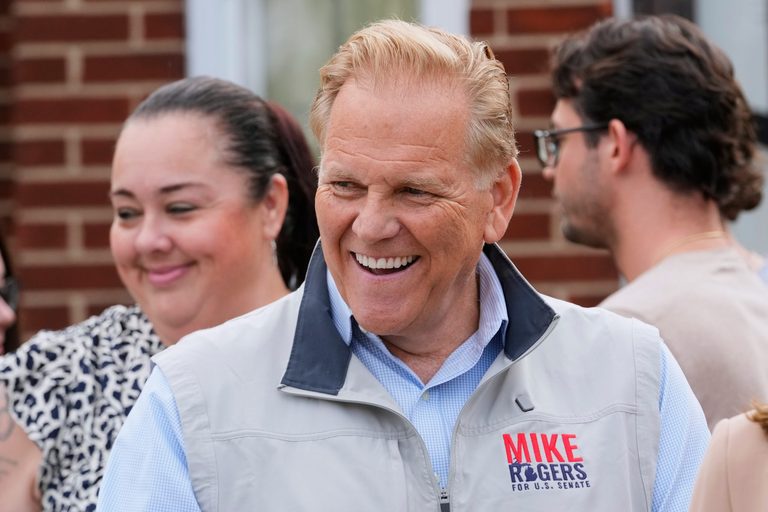
Detroit – On a drizzly morning at Cody High School, former congressman Mike Rogers stood before a small crowd and warned that Michigan’s declining reading scores are a civil‑rights crisis. Rogers, the Republican nominee for the open U.S. Senate seat, used the event to launch a grassroots push into Wayne County, the state’s most diverse area and a Democratic stronghold.
Appealing to Democratic voters
Rogers’ campaign believes that winning over Black and Jewish voters in Detroit could provide the narrow margin needed to defeat progressive Democrat Abdul El‑Sayed in November. The strategy hinges on the fact that in the 2024 Senate race, Democrat Elissa Slotkin beat Rogers in Wayne County by more than a two‑to‑one margin – a gap of roughly 264,000 votes. Even a modest shift of a few percentage points could tip the balance.
Rogers points to El‑Sayed’s positions on U.S.–Israel relations, his past support for an “uncommitted” primary campaign aimed at pressuring the Biden administration over Gaza, and his controversial remarks after the March attack on Temple Israel as reasons why some Black and Jewish voters might be receptive to a Republican alternative.
Building a coalition
While courting Democratic‑leaning voters, Rogers is also working to energize the Trump base. The Trump political team has earmarked $18.5 million for Michigan advertising – the most it has spent on any 2026 Senate race – through the “No Going Back” entity linked to the former president’s MAGA Inc. super PAC. Rogers’ own ads stress his middle‑class upbringing, his congressional record, and a promise to lower health‑care costs, while deliberately avoiding direct references to President Trump.
Rogers’ campaign finance chairman, Bobby Schostak, described the effort as “threading a needle,” balancing outreach to traditional Republican voters with appeals to independents and disaffected Democrats.
Local issues and policy proposals
Beyond voter outreach, Rogers highlighted two local initiatives. First, a nonprofit literacy program aimed at improving reading scores in Detroit’s schools. Second, a home‑construction plan targeting thousands of vacant lots that remain unused nearly two decades after the Great Recession. Both proposals are framed as ways to revitalize the city’s economy and strengthen families.
Rogers also cited his support for reducing federal health‑care spending, a stance that resonates with many Michigan families concerned about rising premiums.
Opposition and criticism
Democratic leaders have dismissed Rogers’ overtures as political opportunism. State party chair Curtis Hertel said, “I don’t think anyone’s buying it. I don’t think Rogers has a connection in those communities, and he’s going to have a hard time.” Nonetheless, some local Jewish and Black activists have expressed unease with El‑Sayed’s past statements, including his description of the Gaza campaign as “genocide” and his comment that “hurt people hurt people.”
Oakland County real‑estate broker Benji Rosenzweig, a Jewish Democrat, announced he will vote for Rogers, stating, “As a Jew, my family doesn’t feel safe with Abdul El‑Sayed.” The endorsement underscores the campaign’s focus on personal safety and cultural concerns.
Implications for Senate control
If Rogers wins, Republicans would retain their Senate majority even if Democrats pick up as many as four GOP‑held seats in the November election. The race has become a top priority for the Trump political operation, which sees Michigan as a critical battleground state.
Ad spending in Michigan has already topped $125 million since the August primary, reflecting the high stakes for both parties. Super PACs aligned with GOP Senate leadership have aired ads linking El‑Sayed to left‑wing streamer Hasan Piker and to proposals to abolish U.S. Immigration and Customs Enforcement.
Rogers’ messaging attempts to distance him from President Trump’s low approval ratings on the economy, while still echoing themes that resonate with Trump supporters. In a recent ad, he declares, “Michigan comes first.” At a Republican midterm convention in Dallas, Rogers referenced “radical Islamic terrorism” and criticized El‑Sayed’s choice of Piker as a running mate, but he did not mention President Trump by name.
As the campaign heads into the final stretch, Rogers will continue to blend appeals to faith‑based communities, family‑oriented economic policies, and a promise to prioritize Michigan’s interests above partisan politics.
Original reporting: Alexandria, VA News – WTOP News — read the source article.