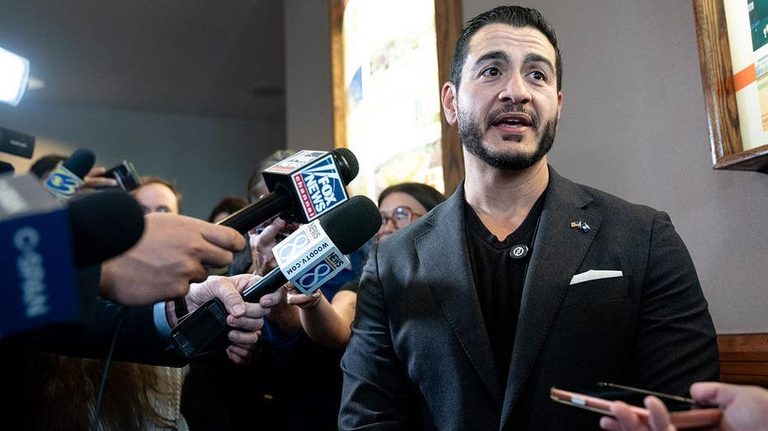
At a 2018 Michigan gubernatorial forum, Democratic U.S. Senate nominee Abdul El‑Sayed faced pointed questions about alleged connections to the Muslim Brotherhood and the prospect of Sharia law influencing state policy. Lawmaker Patrick Colbeck, then a Republican candidate for governor, cited El‑Sayed’s former role as vice‑president of the Muslim Students Association (MSA) at the University of Michigan, a group listed in a strategy memorandum authored by a known Brotherhood member.
El‑Sayed’s response
When asked whether Sharia law was a real concern for Michigan, El‑Sayed answered firmly, “I solemnly swear to uphold the Constitution of the United States and the Constitution of this state — that’s the oath that if any one of us is elected, we will swear. I take that oath particularly seriously because it guarantees me the right to pray as I choose to pray. Sharia law is not in question in this state.” He emphasized that his personal faith would not dictate public law.
Context and criticism
Colbeck warned that the issue was “civilization jihad,” suggesting that any ties to the Brotherhood could pose a threat to American values. While the United States does not designate the Muslim Brotherhood as a terrorist organization, several foreign governments—including Egypt, Saudi Arabia, the United Arab Emirates, Bahrain and Russia—have done so, citing the group’s historic armed activities.
The Brotherhood’s own 2012 document describes a goal of codifying Islamic law in societies, a stance that many conservatives view as incompatible with the Constitution’s guarantees of free speech, religious liberty and women’s rights. Representative Chip Roy (R‑TX) has repeatedly warned that the spread of Sharia law threatens the nation’s Western values.
Local reactions
In Dearborn, Michigan, a city with a significant Middle Eastern and North African population (about 54.5% per the 2020 Census), Pastor Lorenzo Sewell of 180 Church called for the city council to denounce what he described as a “city that is no longer up under American laws; we are up under Sharia law.” The pastor’s remarks reflect broader community concerns about perceived preferential treatment toward Muslim residents.
Fact‑check and campaign stance
Fox News Digital has found no evidence linking El‑Sayed directly to the Muslim Brotherhood. The memorandum that lists the MSA also includes a wide array of unrelated organizations, such as the Islamic Book Service and the Association of Muslim Scientists and Engineers, which maintain no formal ties to the Brotherhood.
El‑Sayed’s campaign reiterated that he supports the separation of church and state. A spokesperson told the Washington Free Beacon that while El‑Sayed lives by his faith, he opposes any effort by any religious community to embed its laws into U.S. legislation.
Implications for voters
Michigan voters will weigh El‑Sayed’s past affiliations against his stated commitment to the Constitution as they head toward the 2026 Senate race. The debate underscores the ongoing national conversation about religious freedom, constitutional fidelity, and the role of faith in public office.
Original reporting: Fox News (HLL/CB) — read the source article.