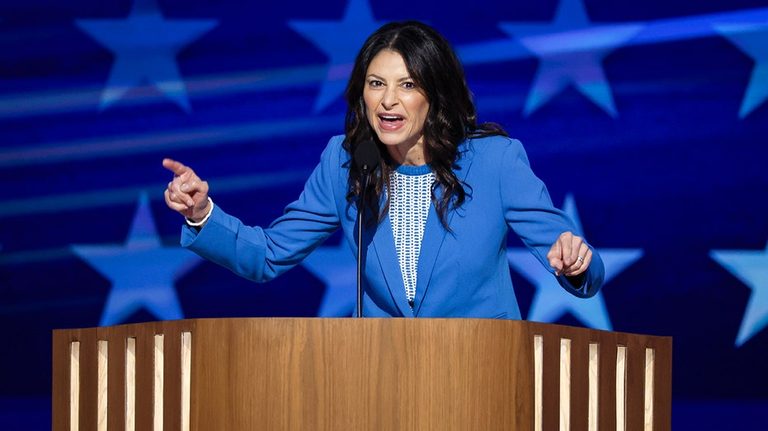
LANSING, MI — The Michigan Democratic Party’s August 29 state nominating convention is shaping up as a flashpoint for an internal battle over U.S. support for Israel. Attorney General Dana Nessel, the state’s Jewish AG, announced she will not attend the event, citing personal safety concerns after anti‑Israel activists disrupted a prior gathering in April.
Security worries prompt AG’s boycott
During a recent round‑table discussion, Nessel explained, “I don’t feel safe going. I feel like my presence isn’t going to be welcome. I don’t want to get chased around, harassed, or booed off the stage.” She referenced the loud protests that silenced Rep. Haley Stevens, a pro‑Israel Democrat, at the April convention.
Party response and ongoing tensions
The Michigan Democratic Party issued a statement affirming its commitment to safe, secure events for all attendees. Spokesperson Derrick Honeyman said the party “rejects antisemitism, Islamophobia, and all forms of hateful conduct” and is working with stakeholders to prepare for the upcoming convention at the Lansing Center.
Jewish Democratic leaders remain divided. Joan Lowenstein, chair of the Michigan Democratic Jewish Caucus, told Fox News Digital she has not heard anyone say they feel unsafe, though she acknowledged some participants anticipate an “unpleasant” atmosphere. Rabbi Asher Lopatin, speaking after joining Republican Senate nominee Mike Rogers at a campaign event, condemned the intimidation of the state AG as evidence of “extremists” within the party.
Impact on the 2026 Senate race
The convention comes weeks after Abdul El‑Sayed, a vocal critic of Israel who has described the war in Gaza as “genocide,” narrowly defeated Rep. Stevens for the Democratic Senate nomination. El‑Sayed, a former Wayne County health director, would become the nation’s first Muslim senator if elected. He has called for ending unconditional U.S. military aid to Israel and has faced criticism from Jewish voters for his remarks.
Rogers, the Republican nominee, has highlighted concerns from Jewish Democratic voters, noting that some young women at the University of Michigan fear walking to class because they cannot display the Star of David. He warned that “violent rhetoric … is going to make a difference” in the general election.
Local voices weigh in
Longtime Democrat Stacy Gittleman, who attended the April convention, observed a predominance of Palestinian flags over American flags and described the lack of decorum as evidence of the party’s leftward drift. Meanwhile, a group of Jewish leaders is circulating an open letter urging Jewish Democrats and independents to support Rogers, framing the moment as a “do‑or‑die” decision for the community.
Lowenstein, while not endorsing the letter, said many Jewish voters feel torn between supporting a Democratic Senate candidate who opposes Israel and voting for a Republican who promises stronger security for the Jewish community.
Broader implications
The dispute underscores a widening fault line within Michigan’s Democratic Party, mirroring national debates over foreign policy, religious liberty, and the role of partisan activism at party events. As the state prepares for a pivotal midterm election, the handling of antisemitism and intra‑party dissent could influence voter turnout and party unity.
Both parties will be watching closely how the convention proceeds, whether security measures satisfy concerned officials, and how the controversy shapes the broader narrative of the 2026 elections in Michigan.
Original reporting: Fox News (HLL/CB) — read the source article.