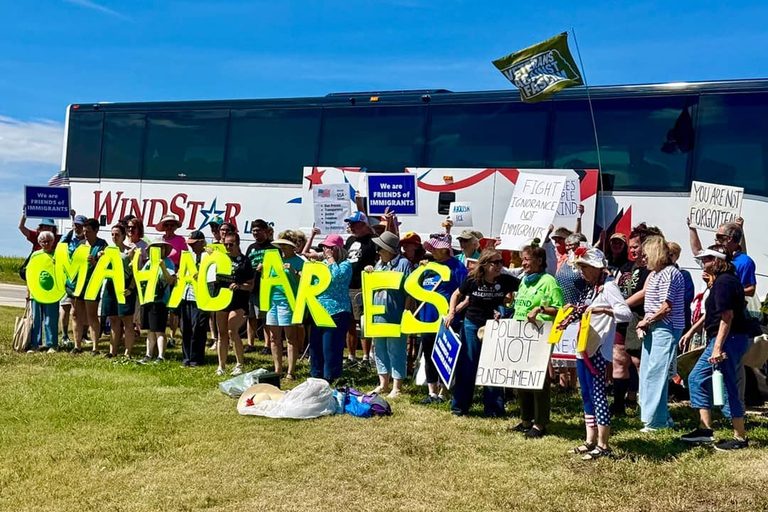
On Saturday, a bus carrying nearly 60 mothers and other community members departed Omaha for a protest at the ICE detention facility in rural McCook, Nebraska. The rally marked one year since Governor Jim Pillen announced a partnership with U.S. Immigration and Customs Enforcement to transform the state’s Work Ethic Camp into a 300‑bed jail for illegal detainees.
Local opposition and state response
Protesters marched to a private lot near the detention center, holding signs that read “We have not forgotten.” They joined a larger crowd that grew to about 300 people, including representatives from Nebraska Voices, the Taco Tuesday Familia advocacy group, and the ACLU of Nebraska. Organizers said the turnout demonstrated a continued resolve to demand due process and legal reform for migrants.
Governor Pillen’s office reiterated its commitment to the partnership, emphasizing “safe and secure detention of illegal detainees accused of either criminal or civil violations of our nation’s laws.” The contract with ICE runs through at least September 2027, and the state has so far received $14.6 million in federal payments—$9.3 million based on occupied beds and $5.3 million for one‑time costs such as vehicles and equipment.
Legal challenges and legislative scrutiny
Thirteen McCook residents and former State Sen. DiAnna Schimek sued to halt the conversion, arguing the governor may have violated the Nebraska Constitution by repurposing a state correctional facility without direct legislative approval. A Red Willow County district judge ruled in favor of the governor, noting that the Legislature has previously tasked the executive branch with managing state prisons. The plaintiffs have appealed.
Within the Nebraska Legislature, a bipartisan group of 13 Democrats and one independent has called for greater transparency, questioning whether the deal bypassed proper legislative oversight. State Sen. Margo Juarez raised concerns about newly constructed “isolation rooms” at the facility and requested an accounting of their use.
287(g) partnership expands state involvement
When the ICE jail was announced, Governor Pillen also disclosed a new 287(g) agreement between ICE and the Nebraska State Patrol. Initially, six troopers were trained as 287(g) task‑force officers; that number has risen to 16. According to a state patrol spokesperson, troopers have assisted in about 275 immigration‑related detentions or transports across 30 counties, with the federal government reimbursing the patrol $277,037.
Critics, including ACLU attorney Grant Friedman, argue the partnership turns the state police into an extension of federal immigration enforcement, raising constitutional and civil‑rights concerns.
Community voices and broader context
Speakers at the rally included Lakota elder Kevin Abourezk, who reminded attendees that the United States’ history of settlement began long before modern immigration debates. Local resident Holly Burns shared her Latino family’s Nebraska roots, noting that historic border changes have long affected her ancestors.
Data from the Transactional Records Access Clearinghouse shows roughly 70 % of ICE detainees have no criminal convictions, underscoring the protestors’ focus on family separation and community impact.
The McCook detention center remains operational, with renovations slated for completion later this summer, potentially allowing the facility to reach its full 300‑bed capacity.
Original reporting: KRDO (Colorado Springs metro) — read the source article.