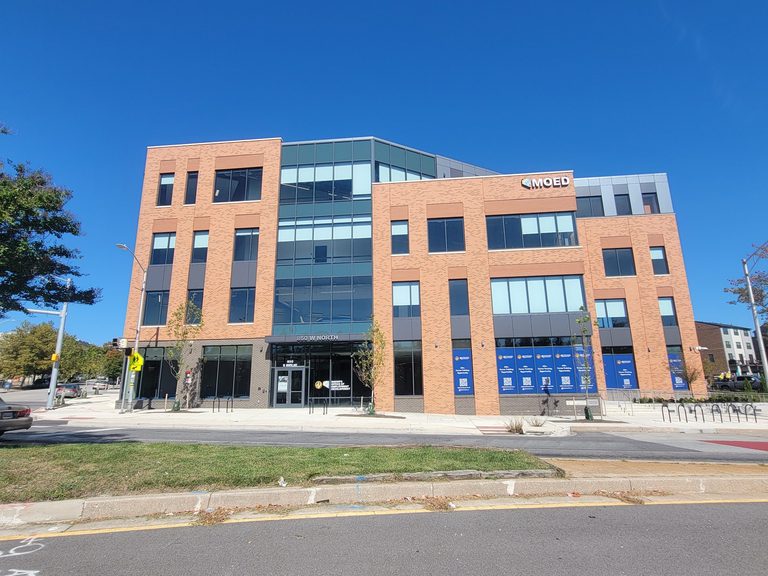
MCB Real Estate is putting the final touches on a new four‑story, $44 million office building at 850 West North Avenue in Baltimore. The 63,000‑square‑foot structure will serve as the headquarters for the Mayor’s Office of Employment Development (MOED), which connects residents with job‑placement services, training programs, and employer partnerships.
Project background and timeline
The building is part of the $170 million Reservoir Square mixed‑use development that also includes market‑rate townhouses built by Ryan Homes. Groundbreaking for the employment hub took place on June 30, 2025, and construction is now substantially complete, with the interior already furnished. MCB Managing Partner P. David Bramble and other development partners addressed a group of invited guests at a preview event, highlighting the project’s role in expanding Baltimore’s workforce resources.
MOED has branded the new site the “American Job Center.” A sign on the first‑floor window notes that the center will open to the public in late fall 2026, and that Baltimore residents age 18 and older can receive in‑person assistance at the Employment Connections Center and Neighborhood Job Hubs before the official opening.
Harborplace PILOT agreement in the works
While the North Avenue office prepares to open, city officials are advancing a Payment In Lieu of Taxes (PILOT) agreement that would dramatically lower the property‑tax burden for MCB’s planned Harborplace redevelopment. The proposal calls for the demolition of the two Harborplace pavilions at Pratt and Light streets and their replacement with two residential towers, office space, retail, restaurants, and open‑space amenities.
The Baltimore Development Corporation has already approved MCB’s application for a PILOT arrangement, but the final terms must still be cleared by the city’s Board of Estimates. According to a draft lease obtained by the Baltimore Brew, the agreement would limit MCB’s tax payments to five percent of the city’s real‑property taxes that would otherwise be due, based on the low assessed values that existed before construction begins. The draft suggests that, even if the development adds roughly $500 million in value, MCB would likely pay no more than $1 million per year in total property taxes, compared with an estimated $11 million under the current tax rate.
The projected annual tax savings of about $10.2 million would begin by 2031, the year MCB expects to complete the Harborplace project, and would continue for roughly twenty years thereafter.
Next steps for the lease and development
City officials plan to present the revised lease and PILOT terms to the Board of Estimates at its next meeting on October 21. The mayor’s office is also considering requesting a special meeting of the board to expedite consideration of the lease. If approved, MCB would lease a total of 4.5 acres of city‑owned land—including the existing 3.2‑acre Harborplace site, an additional one‑acre open space called McKeldin Square, and a five‑lane stretch of Light Street—under a long‑term agreement that could include profit‑sharing provisions.
The Harborplace redevelopment, projected to take five years or more, is intended to revitalize a key waterfront corridor, add housing options, and generate new commercial activity. The city’s pursuit of a favorable PILOT reflects its commitment to encouraging private investment while protecting taxpayers.
Community impact
Both the new American Job Center and the Harborplace project are positioned as engines of economic opportunity for Baltimore families. By consolidating employment services in a modern, centrally located facility, MOED aims to improve access to meaningful jobs for residents across the city. Meanwhile, the Harborplace redevelopment promises new residential units, retail choices, and public spaces that could enhance quality of life in the downtown area.
Stakeholders, including local business leaders and neighborhood groups, are watching the upcoming Board of Estimates vote closely, as the final terms will shape the fiscal landscape for one of Baltimore’s most ambitious private‑development initiatives in years.
Original reporting: Baltimore Fishbowl — read the source article.