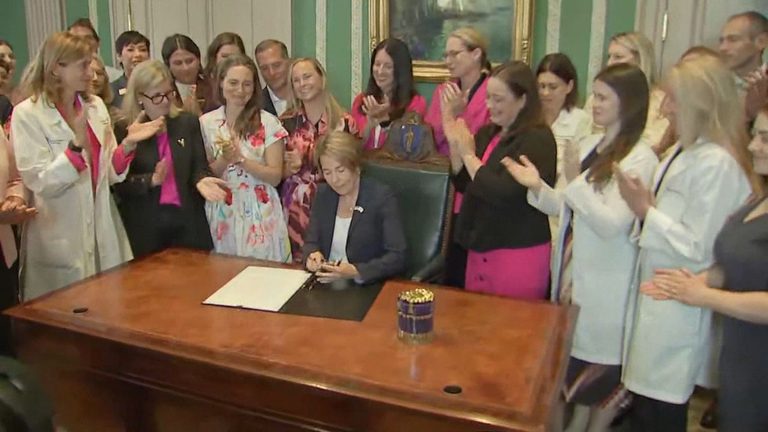
Boston, Mass. – Governor Maura Healey acted swiftly last week to protect a controversial state law that allows physicians greater discretion for abortions after 24 weeks of pregnancy. By signing an emergency declaration on Friday, Healey prevented opponents from suspending the statute while they pursue a statewide referendum to repeal it.
What the law changes
The legislation expands the circumstances under which doctors may perform abortions beyond the 24‑week mark. Previously, Massachusetts law limited post‑24‑week abortions to narrow situations: when the patient’s life was at risk, when her physical or mental health was endangered, or when a serious diagnosis of the unborn child was confirmed.
Governor’s rationale
In the emergency preamble, Healey emphasized that the measure does not override existing professional standards of care, informed‑consent requirements, licensing rules, or facility oversight. “Under the Act, abortions after 24 weeks will continue to be extremely rare,” she wrote, underscoring her belief that the law balances medical judgment with the protection of unborn children.
Opposition and signature drive
Critics of the law argue that it removes protections for unborn children in the ninth month, even when the fetus is viable. Sam Miele, chairman of the Compassionate Care Coalition, said, “To remove every protection for the unborn in the ninth month, even for viable babies, we thought there was no medical justification for that.”
Opponents have collected more than 113,000 signatures to trigger a statewide referendum, more than double the roughly 50,000 signatures required to temporarily suspend the law while the referendum process moves forward.
Legal and procedural context
Massachusetts law permits a petition to suspend a statute if enough signatures are gathered, but the governor’s emergency order blocks that suspension pending further review. The move keeps the law active while the public debate continues, allowing the state’s health‑care system to operate under the new guidelines.
What’s next?
The petitioners plan to submit their signatures to the Secretary of the Commonwealth, which will verify the numbers and set a timetable for the referendum. If the measure reaches the ballot, voters will decide whether to keep or repeal the post‑24‑week provisions.
Governor Healey’s administration has indicated that it will continue to defend the law, citing the importance of physician discretion and the need to protect both patients and unborn children. The debate is expected to intensify as the signature deadline approaches and the state prepares for a potential statewide vote.
Original reporting: NBC 10 WJAR (Sinclair) – local — read the source article.