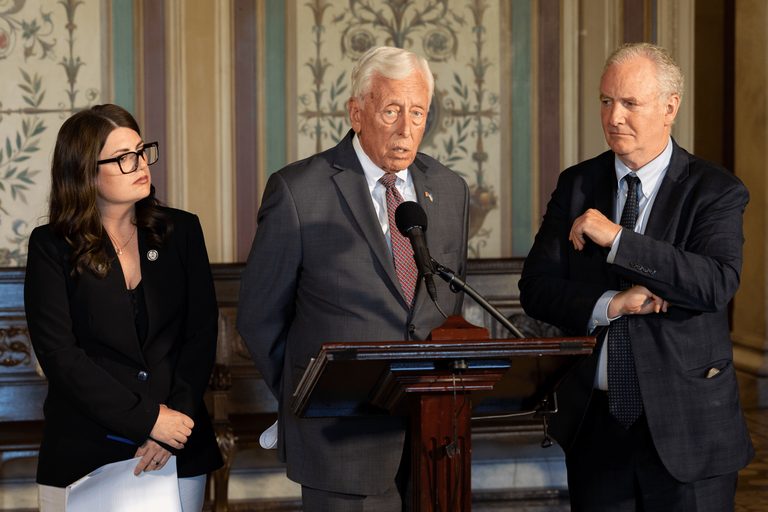
Washington — Two and a half years after the Francis Scott Key Bridge collapse, Maryland’s congressional delegation gathered Thursday with Port of Baltimore officials, the Army Corps of Engineers and other stakeholders to press for additional federal investment in the harbor’s infrastructure. The meeting underscored the urgency of modernizing the port, a critical engine of the state’s economy that supports more than 273,000 Maryland jobs.
Federal Funding Requests and Recent Projects
Delegates highlighted recent successes, including the $495 million Howard Street Tunnel project completed earlier this year. The 131‑year‑old tunnel, once a bottleneck that limited freight movement, now accommodates double‑stacked rail cars, boosting the port’s capacity for container cargo.
Lawmakers also pointed to a nearly $40 million federal allocation announced earlier this year for a new terminal that broke ground in May. The terminal, slated for completion in 2030, is projected to create more than 8,000 jobs and further expand the port’s handling capabilities.
Impact of White House Vehicle Tariffs
U.S. Rep. Sarah Elfreth (D‑MD) warned that the port’s auto imports have fallen sharply, attributing the decline directly to the administration’s recent tariffs on imported vehicles. “We are down, unfortunately, in the number of cars we are importing through the Port of Baltimore,” Elfreth said. “That’s not an accident. That’s because of this President’s decisions.”
While the delegation criticized the tariff policy, they also emphasized that continued investment can mitigate its effects. By expanding terminal capacity and improving rail access, the port can attract a broader mix of cargo, lessening reliance on vehicle shipments.
Legislative Leaders Call for Ongoing Support
U.S. Rep. Steny Hoyer (D‑MD) expressed optimism that sustained funding will keep the port on a growth trajectory. “As long as we keep investing, I think we’re going to see the Port of Baltimore become more and more successful,” he said.
Sen. Chris Van Hollen (D‑MD) echoed that sentiment, noting that the delegation has already submitted a package of requests to the administration. “We worked as a team to submit those requests to the administration, and we’re going to keep pushing for those because we need to keep modernizing the port,” Van Hollen said. “Our goal is to make sure that the Port of Baltimore not only survives but thrives and grows.”
Why Modernization Matters for Maryland Families
The port’s health directly affects Maryland families. Jobs tied to the harbor range from dockworkers and truck drivers to logistics managers and manufacturing staff. Modern infrastructure not only safeguards existing employment but also creates new opportunities in high‑skill, well‑paying positions.
Local business leaders have praised the recent tunnel expansion, noting that faster rail connections reduce shipping delays and lower costs for Maryland manufacturers. With the new terminal slated to open in 2030, the port is positioned to handle a larger share of East Coast container traffic, strengthening the state’s role in national and global supply chains.
Looking Ahead
Although the House of Representatives is currently out of session, Maryland’s delegation says they will continue to advocate for the port’s needs. Their next steps include meeting with Treasury officials to explore additional financing mechanisms and coordinating with state agencies to align local infrastructure projects with federal funding streams.
By keeping the Port of Baltimore modernized and competitive, Maryland lawmakers aim to protect jobs, support families, and ensure the state’s maritime gateway remains a vital component of America’s economic engine.
Original reporting: Baltimore Fishbowl — read the source article.