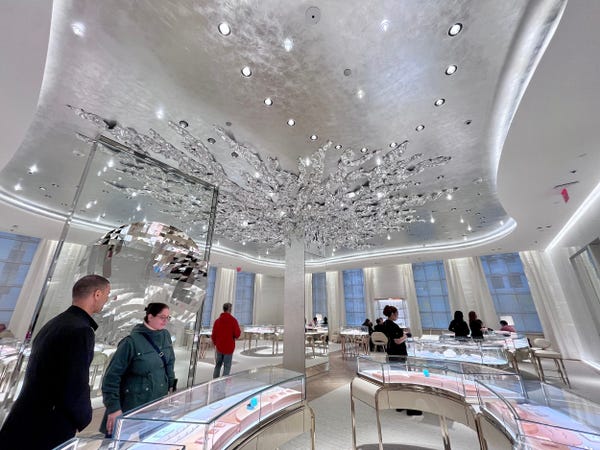
New York City – Luxury houses are opening their doors to the public in a bid to win back younger, aspirational buyers. At Tiffany & Co.’s Jewelry Innovation & Design workshop, guests from Belgium, India and Brazil watched artisans in lab coats clean, carve and 3D‑print silver and diamond pieces under microscopes.
Isabelle Eilenkrig‑Turnier, a Fashion Institute of Technology student, and her mother Inga, recalled the experience as a rare glimpse into the painstaking work that goes into each item. “One thing is to see the beauty, but it’s also the ability to see how much actually goes into making it,” Inga said.
Why the workshops matter
Luxury prices have surged an average 61% between 2019 and 2025, according to McKinsey & Co.’s State of Fashion report, pushing many younger shoppers toward second‑hand markets or newer brands. By showcasing traditional tools – some hammers over a century old – and modern techniques, brands hope to demonstrate that the higher price reflects genuine quality and heritage.
Antoine Arnault, LVMH’s director of image and environment, admitted the luxury sector “is not exactly thriving right now,” but said the annual “Les Journées Particulières” program, launched in 2011, is designed to lift the curtain on the exclusive world of luxury design.
Broader industry effort
Gucci has turned its 105‑year history into museum‑style exhibits, while Chanel’s Galerie du 19m, opened in 2021, displays the craftsmanship behind its products. LVMH is extending the approach to other labels such as Loewe in Spain and Hennessy in France.
Bernstein analyst Luca Solca noted that transparency can attract the growing middle‑class segment, which now represents more than half of the luxury market. “The sooner brands find the appropriate mix to reconnect with aspirational middle‑class consumers, the better,” he said.
Economic backdrop
LVMH reported a 5% revenue decline to $80.8 billion in 2025, marking two consecutive years of falling sales. The company hopes experiential events will reverse the trend by reinforcing brand purpose and trust.
McKinsey’s senior partner Gemma D’Auria warned that post‑pandemic price hikes damaged customer confidence, as shoppers questioned whether product quality matched the higher costs. “Luxury brands need to re‑arm this trust through transparency, through product quality,” she said.
Consumer response
Eleonore Trevisan, a Columbia University student from Luxembourg, said the workshop reminded her why “craftsmanship should stay in culture.” She hopes to own a Tiffany piece one day, adding, “It’s a brand that makes me dream.”
Marketing professors at New York University and Columbia University argue that such hands‑on experiences create value by educating shoppers, making them more willing to commit to a purchase when they see the labor behind each item.
These events signal a shift in the luxury sector: rather than relying solely on heritage and exclusivity, brands are now inviting the public into their ateliers to prove that the price tag reflects real skill, quality and history.
Original reporting: KRDO (Colorado Springs metro) — read the source article.