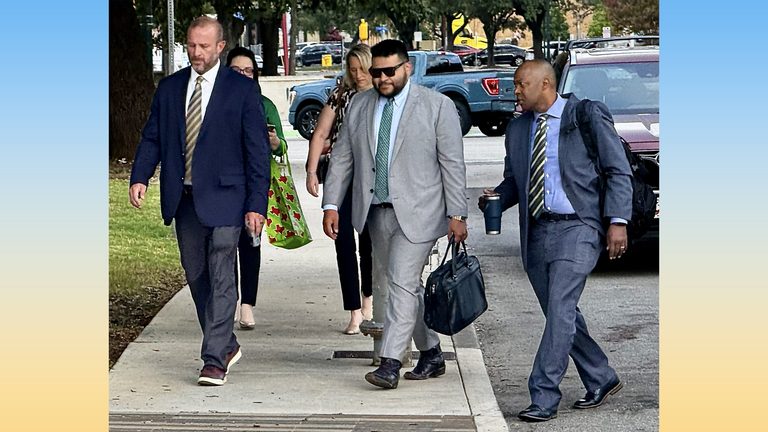
Joshua Allen and Michael Cox, both residents of Lubbock, faced a federal jury in San Antonio this week on charges of conspiracy and securities fraud. Their defense, led by attorney Anthony Box, maintained that Ferrum Capital – the investment firm tied to Allen – transferred the full amount of money it was obligated to send to Collins Asset Group (CAG), the entity at the center of the case.
Key testimony and forensic evidence
During opening statements, Box emphasized that even though the defense’s presentation was shorter than originally scheduled, it still demonstrated that Ferrum Capital fulfilled its financial commitments to CAG. The prosecution, represented by Assistant U.S. Attorney Joseph Blackwell, challenged the credibility of several defense witnesses, including a forensic accountant hired by the defense, Alicia Alvarez.
Alvarez’s report, which relied heavily on bank records and spreadsheets, was limited by a court ruling that barred her from testifying about statements she heard from Allen. The judge, Fred Biery, cited the Sixth Amendment’s Confrontation Clause, referencing Crawford v. Washington, to ensure that any co‑conspirator statements used in the trial were subject to cross‑examination.
Witnesses on both sides
Allen’s mother‑in‑law, Connie Curry, who previously worked for Ferrum Capital, testified that she was surprised to learn the FBI was also investigating Ferrum while she was assisting the agency’s probe of CAG. Curry denied altering any investment documents presented by the prosecution and said she was unaware of any wrongdoing.
Blackwell highlighted metadata that suggested a “Connie” had edited a document, but Curry refuted the allegation. The prosecutor also questioned Alvarez about gaps in her analysis, noting that two of the dozen bank accounts she examined began in January 2023, leaving a missing period from the accounts’ inception in October 2022. Blackwell pointed out a $300,000 inflow during that omitted timeframe.
Financial figures under dispute
The government’s case asserted that Ferrum Capital raised $67 million from investors but only transferred $47 million to CAG. Alvarez’s forensic review, however, indicated that after accounting for “netting” – the practice of combining multiple debts and payments into a single figure – Ferrum actually sent roughly $63 million to CAG.
Netting was illustrated with a specific example: CAG owed Ferrum $2,265,109 for matured investments, while new money due from Ferrum to CAG was $2,192,260. The $72,849 difference represented a netting payment from CAG to Ferrum.
Procedural hurdles and next steps
Before the defense could present its full case, the court spent nearly an hour reviewing charts and redacted documents to determine what could be admitted. Judge Biery expressed concern about the timeliness of Alvarez’s report, noting that it arrived close to midnight and might be excluded entirely.
Both Allen and Cox rested their defenses on Monday, and closing arguments are scheduled for Tuesday, with the jury expected to receive the case around lunchtime. The trial, while taking place in San Antonio, remains a focal point for Lubbock residents who have followed the story closely through local coverage.
Community response and coverage
Lubbock Lights, the outlet reporting the trial, disclosed that the coverage has required a travel budget exceeding $4,000 for hotels and gas. The organization has raised $4,115 through donations and noted that three prosecution witnesses also contributed financially to the reporting effort.
As the case proceeds, the defense’s assertion that Ferrum Capital fulfilled its obligations will be tested against the prosecution’s financial calculations. The outcome will have implications for investors, local businesses, and the broader conversation about securities fraud accountability.
Original reporting: Lubbock Lights — read the source article.