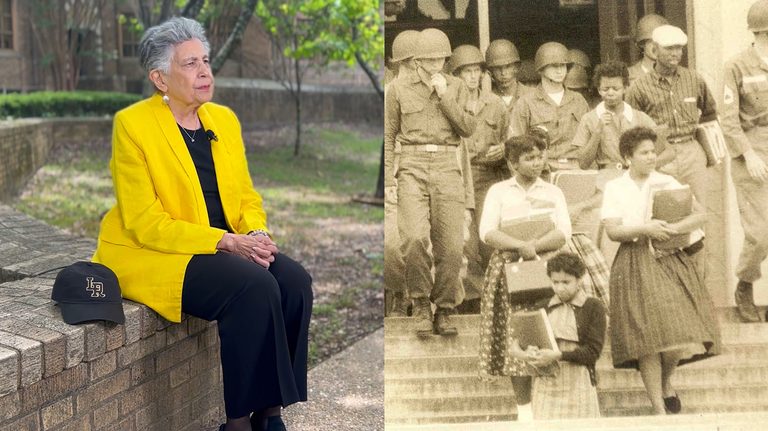
In 1957, nine Black students, known as the Little Rock Nine, faced hostility and resistance as they integrated Little Rock Central High School, testing the Supreme Court’s Brown v. Board of Education ruling and reshaping America’s fight for equality.
A Courageous Stand
Carlotta Walls LaNier, who was just 14 years old at the time, became the youngest member of the group. She felt justified in her decision to attend the school, citing the Brown v. Board of Education ruling as the basis for her right to be there.
When the students arrived on campus, they were met with an angry mob and were turned away by the Arkansas National Guard. President Dwight D. Eisenhower later intervened, federalizing the National Guard and deploying the 101st Airborne Division to escort the students into the school.
A Lasting Impact
The events that unfolded in Little Rock had a profound impact on the Civil Rights Movement, paving the way for landmark legislation such as the Civil Rights Act, the Voting Rights Act, and the Housing Act. LaNier reflected on the broader impact of the events, saying, ‘The Civil Rights Act, the Voting Rights Act, the Housing Act, all of those acts came out of that Brown versus Board of Education.’
As the country approaches its 250th anniversary, LaNier emphasized the importance of reflection and unity, stating, ‘Think about what we can do to hold those true to us, true to We the People, because this is our country, all of us. It’s not for whites, it’s not for Blacks, it’s not for browns, it’s for everybody.’
Original reporting: 40/29 / KHBS (NW Arkansas) — read the source article.