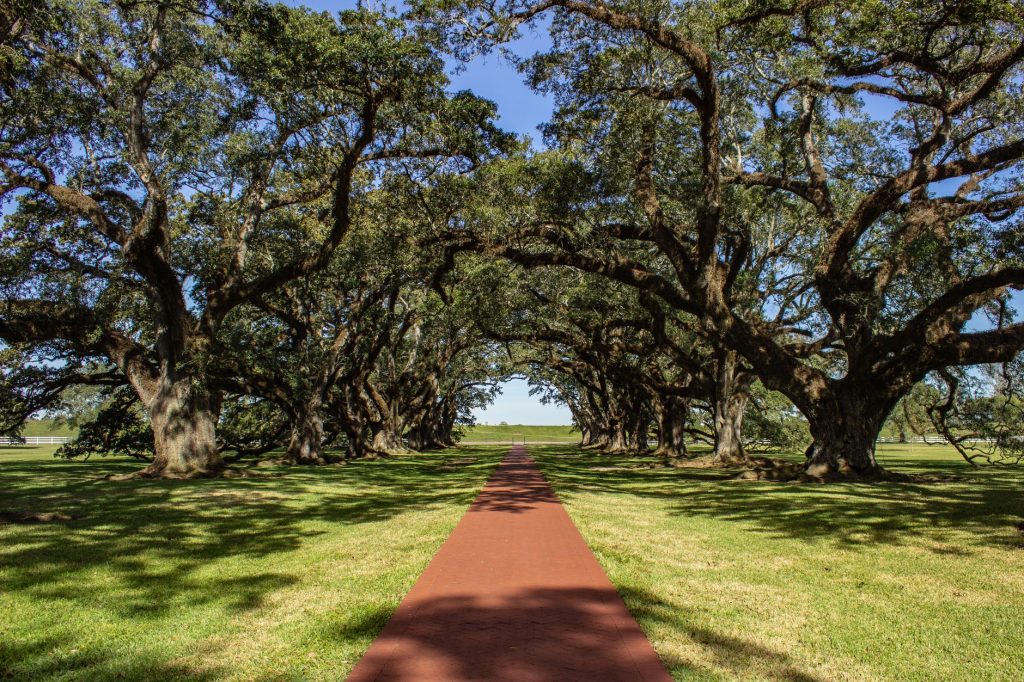
By seven in the morning, the mist still sits low across the rice fields on Willbrook Boulevard, and the live oaks lining Litchfield Plantation’s entrance avenue have not yet caught any direct sun. That is exactly the right time to drive in. The canopy closes overhead almost immediately — two rows of old oaks, Spanish moss hanging so thick it muffles sound — and for a quarter mile you feel like you have wandered onto a set that nobody bothered to build because it was already there.
The avenue leads to what remains of the original Litchfield Plantation, a Carolina rice plantation dating to the 1740s. The main house still stands, now operating as part of the Litchfield Beach & Golf Resort property, but the structure most worth seeing is the tabby ruins of the old slave quarters and outbuildings set off to the side, accessible from the main drive. Tabby — a building material made from burned oyster shells, lime, sand, and whole shells — was common across the South Carolina Lowcountry, and what survives here is among the more intact examples in Georgetown County. The walls are waist-high in places, chest-high in others, and you can still read the floor plan of the rooms if you look carefully.
Nobody is going to hand you a brochure or stop you at a gate. The resort property is accessible, and the plantation avenue is a well-known local route. Visitors walk the allee, photograph the oaks, and study the ruins without much ceremony. There is no admission charge and no organized tour. A small historical marker near the entrance gives basic context, but for more background, the Georgetown County Museum — a short drive north on Fraser Street — has documents and photographs that fill in the history considerably.
What the ruins represent is worth sitting with. Litchfield was a working rice plantation, and the labor behind that rice economy was entirely enslaved. The tabby walls you are walking around were built by enslaved people and housed enslaved people. That is not subtext here; it is the text. The Gullah Geechee heritage of Georgetown County runs directly through sites like this one, and the county has put increasing effort into contextualizing plantation landscapes beyond the romanticism that some older tourism materials leaned on.
The drive itself — especially the oak allee — photographs well in early morning or late afternoon light. Bring a wide lens if you have one. The canopy is dense enough that midday light turns flat and harsh. Spring and fall are the most comfortable seasons for lingering; summer mornings are tolerable if you start before eight, but the humidity arrives fast.
There is no formal parking lot, but the shoulder along the entrance is wide enough for a few cars. Locals use the road as a morning walk route, and you will likely share it with people pushing strollers or walking dogs. That neighborly ordinariness is part of what makes the place feel grounded rather than staged.
Litchfield Plantation sits off Willbrook Boulevard just west of Highway 17, roughly equidistant between Georgetown city limits and Pawleys Island. It is an easy stop on the way to or from either, and it asks almost nothing of you except a little time and a willingness to stand still in front of something old and think about what it actually meant.