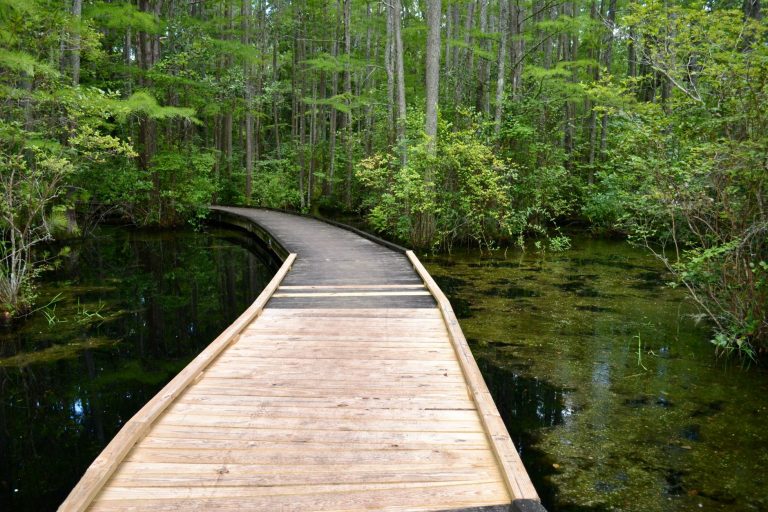
People who live along the Hammock Coast will tell you the same thing: if you want to clear your head, you get on a bike and you ride the Litchfield path. Not the boardwalk, not the strip — this one, threading through maritime forest and past the long driveways of old beach cottages on Willbrook Boulevard and beyond, where the Spanish moss gets so thick it filters the morning light into something almost theatrical.
The trail system at Litchfield Beach & Golf Resort runs through one of the more quietly beautiful stretches of the South Carolina coast, roughly 25 miles south of Myrtle Beach proper. The resort itself dates to the 1970s and covers a serious chunk of land — golf courses, lagoons, beach access, and a network of paved paths that guests use but that tend to feel underused compared to what they deserve. Even on a busy weekend in July, a rider can find long stretches where the only sounds are red-winged blackbirds and the tick of bicycle gears.
The main path runs along the edge of the golf course, looping past lagoons where great blue herons stand in the shallows without any apparent interest in moving. Alligators surface near the banks on warm mornings — not a spectacle, just part of the landscape, and most locals give them the same casual acknowledgment they’d give a neighbor’s dog. The canopy over the path varies: open sky near the fairways, then sudden shade under live oaks, then open again near the dunes. The transitions happen fast enough that the ride feels like it covers more ground than it actually does.
Guests staying at the resort can rent cruiser bikes through the front desk — the rental rate runs around $15 to $20 for a half day, which is reasonable given that you can easily spend three hours without retracing the same stretch twice. Families with younger kids tend to stick to the flatter lagoon-side loops; more experienced riders push out toward the beach access points and the quieter residential edges where the path narrows and the pavement gives way to packed shell gravel.
The best time to go is early — before nine in the morning, before the humidity settles in and before the golf carts start moving in earnest. The air smells like salt and pine needles and something slightly brackish from the lagoons, which sounds like a complaint but isn’t. A few of the path sections pass close enough to the water that you can hear the ocean before you see it, and the moment the dunes open up at the beach access is genuinely satisfying in the way that earned views tend to be.
Non-guests can access portions of the surrounding road network on bikes, and Litchfield itself is a low-traffic corridor compared to most of the Grand Strand. The resort’s paths are primarily for guests, but the surrounding Litchfield neighborhood is navigable and calm enough that cyclists explore it without incident. A few residents have their own cruisers parked under covered porches — the visual shorthand for a place that takes casual biking seriously.
It’s not a trail in the wilderness sense, and it won’t challenge anyone looking for elevation. What it offers is rarer on this coast: a genuine sense of quiet, real natural scenery, and enough distance that the ride actually feels like going somewhere.