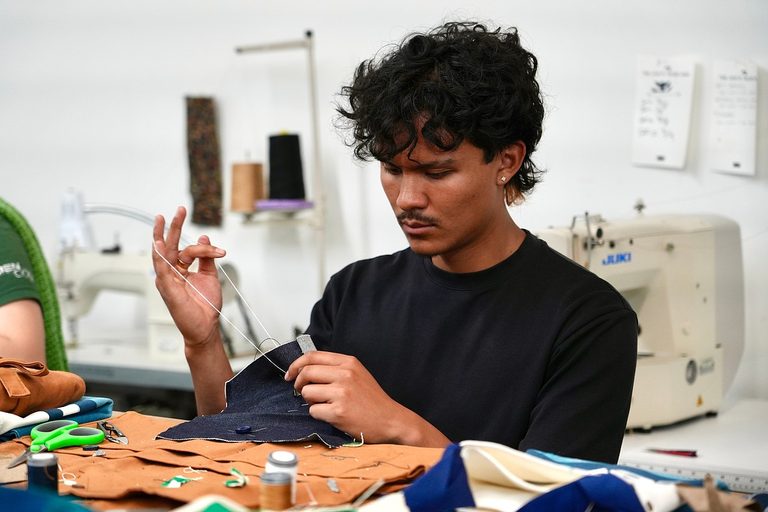
Clothing retailers are turning to hands‑on repair services as a way to win over Generation Z shoppers who are looking for ways to stretch their dollars and reduce waste. Levi Strauss & Co., Uniqlo and Primark have all introduced in‑store sewing workshops and repair stations, offering everything from button replacement to hemming and patching.
Levi’s teaches high‑school students to mend
Levi’s has rolled out a “Wear Longer” program that includes a 90‑minute hand‑stitching course for high‑school students. The curriculum covers four basic tasks: sewing on a button, hemming, patching a hole and fixing a tear. The company says the program, which began in San Francisco and is expanding nationwide, is designed to give young people the skills they need to keep thrift‑store finds in service.
“We think it’s important to empower the people who buy our clothes with the skill sets to maintain them, to get them to that second life,” said Paul Dillinger, Levi’s head of global design innovation.
Primark focuses on education
Primark’s “Love It For Longer” events teach customers how to replace zippers, swap out buttons and perform other simple fixes. The retailer has held more than 730 workshops in nine of the 17 countries where it operates, including several locations in the United States. “Learning how to repair and care for clothing is probably one of the simplest but absolutely effective ways that we can reduce waste and also extend the lifetime of whatever we buy,” said Vicki Swain, Primark’s product longevity and partnership lead.
Uniqlo adds creative after‑care services
Uniqlo offers a suite of after‑care options, from basic repairs to decorative sashiko mending and creative restyling. The services are available in roughly 75 of the brand’s 2,500 stores worldwide and are promoted as a natural extension of the company’s focus on durable wardrobe staples.
Why the shift matters to Gen Z
Generation Z, born between 1997 and 2012, grew up with fast‑fashion cycles and has faced rising living costs and inflation. Many prefer second‑hand purchases and are eager for ways to keep garments usable. Chloe Halprin, a 25‑year‑old Detroit resident, says she now buys most of her clothing secondhand and has learned to hem with a sewing machine to avoid throwing items away.
“I try to be conscientious of my carbon footprint,” Halprin said. “I really don’t like waste. I’m trying to save money as well.”
Environmental impact remains limited
Experts agree that repairing and reselling clothes can lower a garment’s environmental impact, but they caution that these efforts are still a small fraction of overall textile waste. The United Nations Environment Programme estimates the world discards fabric at a rate equivalent to a garbage truck per second. The Ellen MacArthur Foundation notes that clothing production roughly doubled between 2000 and 2015 while the average number of wearings per garment fell by about 36 %.
“Repairing a garment in store happens in addition to these growing production volumes, not instead of them,” said Kate Fletcher, a sustainability professor at Manchester Metropolitan University.
Industry seeks tax incentives
Retailers such as H&M, Primark and ThredUp have called on governments in North America and the European Union to adopt tax policies that would make eco‑friendly services more profitable. H&M, which operates more than 4,000 stores worldwide, notes that manufacturing new garments remains cheaper than keeping existing ones in use, highlighting the economic challenge of scaling repair programs.
Neil Saunders, a retail analyst with GlobalData, said the trend reflects “some deeper consumer needs and behaviors at the moment” and adds that offering repair services can “put a halo on the brand.”
While skeptics question the overall impact, the growing number of in‑store workshops suggests that major brands see value in meeting Gen Z’s desire for affordable, sustainable fashion.
Original reporting: Texarkana Gazette — read the source article.