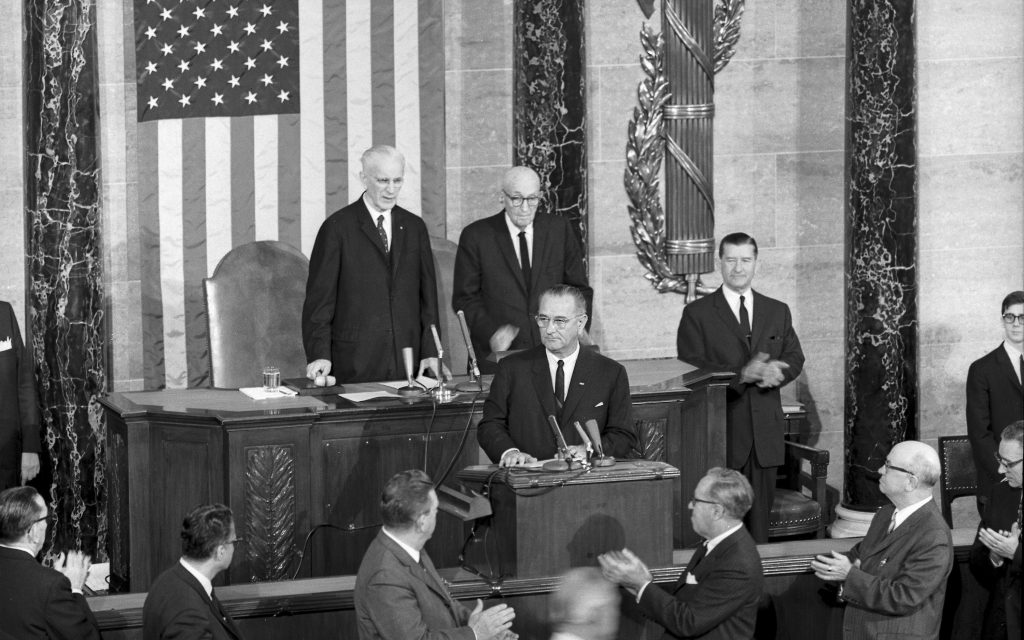
On Wednesday, November 27, 1963, Lyndon B. Johnson stood before the House of Representatives to deliver his first presidential address after assuming office following President John F. Kennedy’s assassination. The speech, crafted largely by Kennedy’s former speechwriter Ted Sorensen, marked a pivotal moment as the nation sought stability and direction.
Historical Context
Vice President Johnson had long been a dominant force in the Senate, earning the nickname “Master of the Senate” for his unrivaled ability to marshal votes. Yet, under Kennedy, he was often treated as a secondary figure, a dynamic that left him feeling marginalized. The sudden transition thrust Johnson into the highest office at a time of profound national trauma.
The Address
Johnson opened his remarks with solemn reverence: “The greatest leader of our time has been struck down by the foulest deed of our time… No words are strong enough to express our determination to continue the forward thrust of America that he began.” He emphasized continuity, urging Congress to pass the civil‑rights legislation that Kennedy had championed.
Throughout the speech, Johnson projected confidence and resolve, despite his reputation as a less polished public speaker. He spoke slowly, emphasizing the need for unity and moral courage. Applause punctuated the address 31 times, reflecting both support and lingering dissent, particularly from Southern senators who opposed civil‑rights reforms.
Key Themes
- Call for Unity: Johnson warned against “the apostles of bitterness and bigotry,” urging the nation to reject extremism and hatred.
- Civil‑rights Commitment: He urged Congress to pass a new civil‑rights law for Black Americans, positioning the legislation as a continuation of Kennedy’s legacy.
- Faith and Patriotism: Closing with verses from “America the Beautiful,” Johnson invoked divine grace and brotherhood, appealing to shared American values.
Reactions
While many in the chamber were moved to tears, some Southern senators remained stoic, reflecting the deep regional divisions over civil‑rights policy. Historian Robert A. Caro notes that the applause was not unanimous, highlighting the political challenges Johnson would face.
Legacy
Johnson’s address set the tone for his presidency, signaling a willingness to pursue ambitious domestic reforms despite a nation in mourning. The speech foreshadowed the landmark civil‑rights legislation that would become a cornerstone of his administration.
Richard Robbins, the author of the original column, resides in Uniontown and can be reached at [email protected].
Original reporting: Herald-Standard – latest news for Uniontown, Pennsylvania — read the source article.