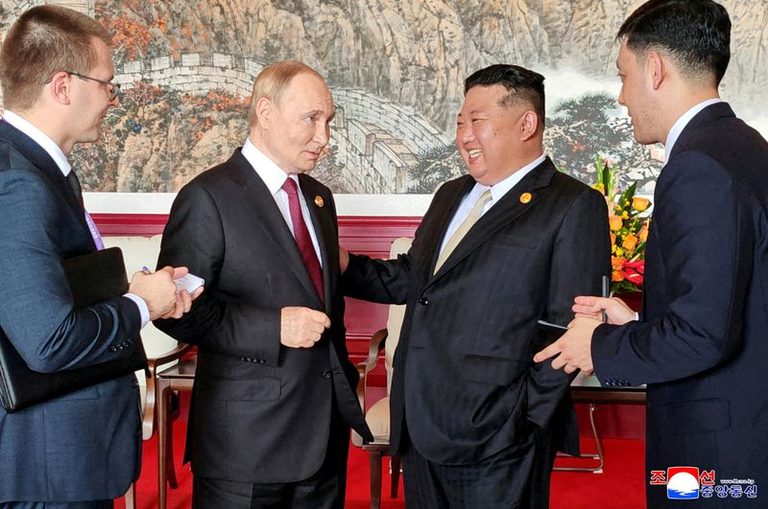
In a message to North Korean Foreign Minister Choe Son Hui, Russian Foreign Minister Sergei Lavrov said the two countries are working together to establish a “new and righteous world order.” The statement, released by North Korea’s state news agency KCNA on Tuesday, highlighted continued cooperation in all areas and a shared commitment to regional and international security.
Military cooperation in the Ukraine conflict
Lavrov referenced the deployment of roughly 14,000 North Korean soldiers to Russia in late 2024, which he said helped Moscow repel a major Ukrainian incursion into the Kursk region. Russian President Vladimir Putin declared victory in May 2025 and publicly thanked Pyongyang for its assistance. Lavrov described the Korean People’s Army personnel as proof of a “militant friendship forged by heroic preceding generations.”
Broader strategic goals
The Russian minister said the partnership aims to create a world order founded on “genuine equality and national interests.” He framed the collaboration as a response to what Moscow characterizes as a Ukrainian “Nazi clique” and foreign mercenaries operating in the region. The language mirrors Russia’s long‑standing narrative that portrays President Volodymyr Zelenskiy’s government as extremist, a claim dismissed by Zelenskiy and his Western allies.
Western concerns
South Korean officials and Western governments have expressed worry that North Korea may be receiving weapons‑development assistance from Russia in exchange for its troops. Recent reports suggest Pyongyang has supplied Russia with artillery and mortar rounds, ballistic missiles, long‑range artillery and multiple‑launch rocket systems. Ukrainian and independent analysts have documented these transfers, noting they could enhance Russia’s military capabilities.
Potential future deployments
Earlier this month, President Zelenskiy warned that up to 50,000 additional North Korean soldiers could be sent to Russia in a new deployment, further escalating military pressure on Ukraine. The prospect of a larger North Korean presence has heightened anxieties among NATO allies and raised questions about the stability of the broader security environment in Eastern Europe.
Implications for international relations
Lavrov’s remarks underscore a deepening alliance between Moscow and Pyongyang, challenging the diplomatic efforts of the United States, South Korea and their partners to isolate both regimes. By framing their cooperation as a pursuit of “righteous” global order, the two governments signal a willingness to confront what they view as Western hegemony.
The exchange also highlights the ongoing information battle surrounding the Ukraine war. While Russia continues to label Ukrainian forces as extremist, Kyiv and its allies maintain that such characterizations are unfounded and serve propaganda purposes.
As the conflict enters its fifth year, the involvement of additional foreign troops and advanced weaponry could prolong hostilities and complicate peace negotiations. Observers note that any further escalation may draw more nations into the dispute, raising the risk of a broader regional confrontation.
Original reporting: Appleton, WI News Feed (HLL/CB) — read the source article.