It was 11 on a Tuesday morning when I pulled off Route 40 and parked in the gravel strip beside the Searights Tollhouse, and there was exactly one other car there — a minivan from Ohio, which pulled away before I even got out. That left me and the tollhouse and a historical marker that almost nobody reads anymore, standing together on the old National Road like some kind of slow-news-day tableau.
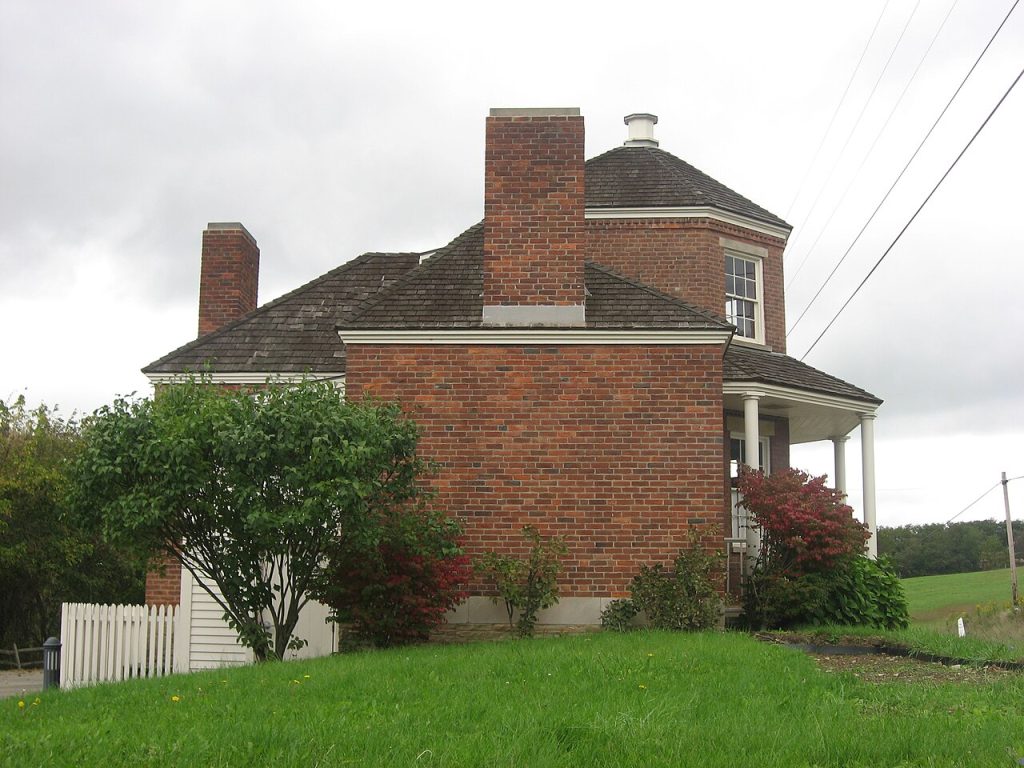
The Searights Tollhouse has been sitting at this spot in Uniontown’s southwestern edge since 1835, which means it has now outlasted several empires, the American canal system, and at least a dozen local restaurants that people swore would make it. It’s a small, octagonal stone building — almost comically solid for its size — built to collect tolls on what was then the most important road in the country. The National Road was how westward expansion actually moved. Settlers, wagons, mail coaches, livestock. This little stone booth was the physical checkpoint on that flow of American ambition, which is either deeply significant or deeply ironic depending on your mood.
The tollhouse is maintained by the Pennsylvania Historical and Museum Commission, and admission is free, which you’ll appreciate after realizing the site’s interpretive offerings are lean. There’s a small exhibit inside about tollkeeping and the road’s history, and a docent on duty during open hours who can tell you more than the plaques do. When I was there, a volunteer named Earl walked me through the toll rate schedule — wagons paid based on wheel width, which I found genuinely surprising — and explained that the keeper and their family lived in the small attached residence. That’s the part that sticks. Someone lived here, collecting coins, watching traffic all day, every day. It’s a strange life to picture.
The building itself is worth a slow walk-around. The stonework is that particular Pennsylvania kind — thick, grey, almost aggressively permanent — and it has survived two centuries on a road that became a highway, which is impressive in a modest way. The surrounding grounds are modest too: a strip of grass, a split-rail fence, a view of Route 40 traffic moving at speeds that would have seemed apocalyptic in 1835. That contrast is the whole experience, really. You’re standing at a physical hinge between the early American road system and a four-lane state route. It’s not dramatic. It’s just old and real and sitting right there.
The tollhouse is open seasonally, generally late spring through early fall, on weekends and some weekdays — hours vary, so calling ahead or checking the PHMC site before you drive out is worth the thirty seconds. It costs nothing to visit. It will take you maybe forty-five minutes if you read everything and talk to whoever’s there, twenty if you don’t.
I’ll say this: it’s not a destination on its own, not really. But if you’re driving Route 40 toward Ohiopyle or coming back from Fort Necessity, stopping here costs you almost nothing and pays back more than the equivalent roadside distraction usually does. There’s something grounding about standing in a doorway that was built before the Civil War to manage the flow of a nation on the move, and finding it still standing, still cared for, still right there on the road. Earl seemed pleased I’d stopped. The minivan from Ohio, apparently, had not.