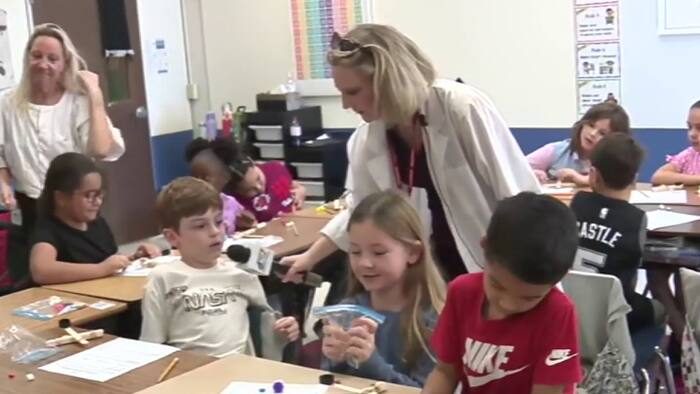
KSAT’s longtime meteorologist Sarah Spivey is extending her on‑air expertise into the classroom. Every Wednesday at 9 a.m., the popular “GMSA@9” segment features Spivey demonstrating two classic science projects that illustrate the principles of simple machines and air pressure.
What the demonstrations cover
First, Spivey builds a balloon‑straw transportation system. By inflating a balloon, attaching it to a straw, and letting the escaping air propel a lightweight object, students see Newton’s third law in action. The activity is inexpensive, requires only a few household items, and reinforces the concept that for every action there is an equal and opposite reaction.
Second, she constructs a popsicle‑stick catapult. Using two sticks, a rubber band and a small projectile, the catapult demonstrates leverage, fulcrum placement and potential energy conversion. The hands‑on model helps students grasp how simple machines amplify force, a foundational idea in physics and engineering.
How schools can participate
Educators interested in bringing these demonstrations to their classrooms need only submit an application through the KSAT website. The process is straightforward: click the “Apply” link, provide basic school information, and indicate a preferred date. Spivey’s team will coordinate a virtual or in‑person session, depending on the school’s resources and local health guidelines.
Because the experiments use everyday materials, teachers can easily replicate them after the live demo, reinforcing the lesson and encouraging students to experiment on their own. Spivey emphasizes that the goal is to spark curiosity about how everyday objects work, laying a foundation for future study in science, technology, engineering and mathematics (STEM).
Why this matters for families and schools
In today’s education climate, hands‑on learning is a proven way to engage students who might otherwise find abstract concepts daunting. By offering free, curriculum‑aligned demonstrations, KSAT supports Texas families and schools in delivering quality STEM instruction without additional cost.
Parents can also benefit. The experiments are simple enough to try at home, turning a weekend activity into a teachable moment about physics and engineering. Spivey encourages families to watch the broadcast together, discuss the science behind the projects, and then try the experiments with household supplies.
How to stay informed
View the weekly GMSA@9 segment on KSAT’s website or local cable channel 12. Follow KSAT on social media for reminders about upcoming demonstrations and additional educational resources. For direct inquiries or to schedule a school visit, use the “Apply” button on the KSAT science outreach page.
By bringing real‑world science into classrooms and living rooms, Sarah Spivey and KSAT are helping Texas students develop the critical thinking skills essential for tomorrow’s challenges.
Original reporting: San Antonio, TX News (HLL/CB) — read the source article.