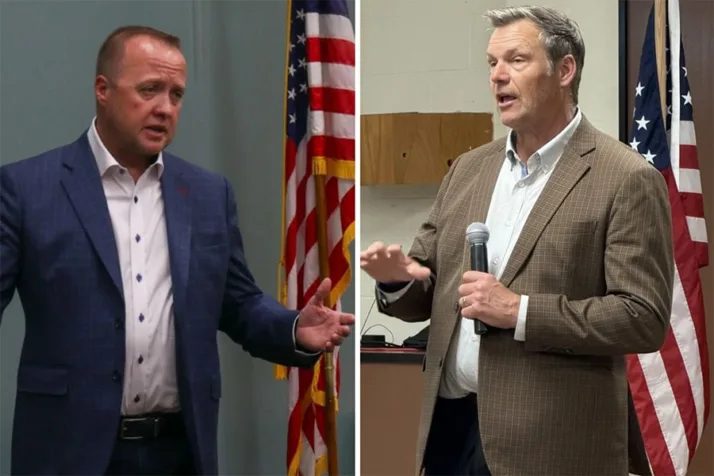
Johnson County, KS – Kansas voters will decide next year whether incumbent Attorney General Kris Kobach retains his post or yields to Democratic challenger Chris Mann. Both candidates have more than doubled their campaign war chests since the 2022 election, with Kobach reporting just over $600,000 cash on hand and Mann holding roughly $640,000, according to the latest finance filings.
Record claims and policy focus
Kobach, a former secretary of state and constitutional‑law professor, told reporters his “four years of results” demonstrate success in the attorney general’s office. He highlighted a decline in certain crime rates and an antitrust lawsuit against a major ticket‑selling platform that he says overcharged Kansas consumers. More recently, Kobach has emphasized a consumer‑protection agenda, citing a national court ruling against Meta that mandates stricter child‑safety guidelines and funds youth mental‑health initiatives.
He also voiced opposition to a proposed railroad merger, arguing in an op‑ed that the deal would create a monopoly and hurt Kansas shippers. Kobach says he can balance these consumer‑focused efforts with his traditional social‑issue positions, including his support for a transgender‑bathroom and ID law and his past push for a constitutional amendment on abortion, which voters rejected.
Democratic challenger’s message
Chris Mann, a former prosecutor and police officer, frames his campaign around “meat‑and‑potatoes” attorney‑general work. He promises to boost assistance for rural law‑enforcement agencies and to crack down on consumer fraud, positioning himself as a steady, non‑flashy alternative to what he calls headline‑grabbing politicians. “People are sick and tired of politicians who are in it for themselves,” Mann said.
Mann also points to Kobach’s past efforts to require proof of citizenship for voter registration, which led to an ACLU lawsuit that cost the state nearly $2 million. He argues that Kobach’s history of pursuing controversial constitutional amendments shows a pattern of prioritizing ideology over practical governance.
Political context
The race unfolds in a midterm year with President Donald Trump occupying the White House. Historically, the party holding the presidency faces headwinds in midterm contests, but Kansas voters have shown independence from national trends. Four years ago, they re‑elected Democratic Governor Laura Kelly despite a Democratic president, and they narrowly chose Kobach over a Democratic opponent in 2022.
Political analysts note that a Republican incumbent perceived as flawed can become a viable target for Democrats seeking a statewide win. Emporia State University political‑science professor Michael Smith said, “Often it takes a Republican opponent that is seen as flawed for Democrats to have a chance.” He referenced past Kansas attorney‑general races, including the 2006 contest where Republican Phill Kline lost to Democrat Paul Morrison.
Fundraising and outlook
While Kobach’s cash on hand slightly trails Mann’s, both campaigns have secured enough resources to run statewide advertising and ground operations. Kobach acknowledges the national Democratic wave may affect Kansas, but he remains confident that his record will resonate with voters who value both consumer protection and traditional conservative principles.
The Kansas Secretary of State’s office will certify candidate filings in the coming weeks, and the primary election is scheduled for August 2026. Voters will receive the final ballot in November, determining whether Kansas continues with a seasoned conservative attorney general or shifts to a Democratic officeholder focused on rural law‑enforcement support and consumer fraud enforcement.
Original reporting: Johnson County Post (Overland Park) — read the source article.